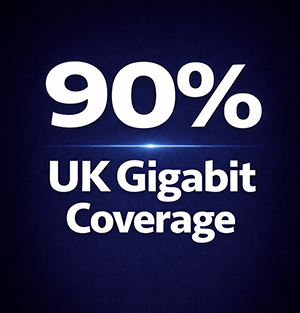
Our tracking of the UK and its constituent councils and 650 constituencies has the UK at 90.04% Gigabit broadband coverage as of 25th February 2026.
90% Gigabit coverage is a significant milestone on the way to the political ambition of 99% Gigabit for 2032, and follows on from the UK reaching the 85% milestone back in October 2024.
Those following the broadband rollouts will be fully aware that the coverage is far from uniform and there are areas of the UK lagging a long way behind, but commercial and Project Gigabit rollouts are having an effect even on those.
- Na h-Eileanan an Iar – 13.5% (up from 6.9% a year ago)
- Shetland Islands – 22.8% (up from 11.7%)
- Argyll and Bute – 28.2% (up from 22.8%)
- Orkney Islands – 30.7% (up from 18%)
- Aberdeenshire – 51.7% (up from 43.4%)
- Perth and Kinross – 59.2% (up from 50.4%)
- North Norfolk District – 60.0% (up from 44.7%%)
- South Hams District – 63.2% (up from 59.4%)
- City and County of the City of London – 63.7% (down slightly from 64.2%)
- Highland 64.1% (up from 50.7%)
The figure for the City and County of the City of London is lower now than a year ago, but still higher than two years ago when it was at 60%. At just 13,975 premises the City is one of the smallest council areas with the Isles of Scilly, Shetland and Orkney Islands being smaller. This means it only takes a small amount of new buildings to appear that do not have SME/consumer Gigabit options available to create this sort of change in the statistics, or a full fibre network to in theory be present in the street and initially marked as Ready for Service only for that to be withdrawn when someone refuses a way leave.
Looking at the UK wide breakdown for nations and regions the change since the overall 85% target was reached is:
- United Kingdom now at 90.04% Gigabit coverage, up from 85.20% on 18th October 2024
- England now at 90.58% Gigabit coverage, up from 86.01%
- South East England 87.27% Gigabit coverage, up from 83.04%
- London 92.90% Gigabit coverage, up from 91.31%
- North West England 93.86% Gigabit coverage, up from 88.67%
- East of England 88.43% Gigabit coverage, up from 82.45%
- South West England 83.53% Gigabit coverage, up from 77.06%
- Scotland 84.69% Gigabit coverage,up from 79.14%
- West Midlands 92.22% Gigabit coverage, up from 88.90%
- Yorkshire and The Humber 94.32% Gigabit coverage, up from 89.49%
- East Midlands 91.45% Gigabit coverage, up from 86.29%
- Wales 86.17% Gigabit coverage, up from 76.04%
- North East England 92.77% Gigabit coverage, up from 86.04%
- Northern Ireland 97.15% Gigabit coverage, up from 96.42%
- (Order is based on number of premises in each area, and % covers both residential and business premises)
No big suprise to see that Northern Ireland is showing minimal change in the last 16 months, as its coverage levels are so high already. Referring to Northern Ireland specifically we see some rollout from Openreach where its full fibre service is the first Gigabit option, otherwise it is down to Fibrus and Government contracts it holds.
Predicting the next milestone is going to be a lot harder as the rollouts are reaching the flattening part at the top of an S-curve, just like we did for the superfast rollouts a decade ago. Commercial rollouts are now looking at overbuild to increase competition or mergers and acquisitions, so even the prediction of 93.25% Gigabit coverage across the UK for September 2028 is open to debate. There are additional Project Gigabit rollouts to add to that figure, but with the number of contract changes and general slow down in the commercial rollouts to areas on the edge of the contracts we suspect that 93.2% for 30 months time might be slightly optimistic unless the economic and investment landscape changes dramatically.
The analysis behind the 90.04% is as has been the case since we started publishing statistics being based on the vast majority of premises in a postcode being able to order a service at the standard list price and be installed in a week or two without any excess charges. A substantial change in the last two years has been embracing mapping the footprints at the address level so people can actually see if full fibre is available to every house on their street, this map is updated at least once a month and can see addresses going from a green dot to nothing over an individual property as rollouts ebb and flow.
We are very confident that the UK has hit the 90% figure, and in the two days since our tracking went from 89.98% to 90.04% we have been making more additions and some removals of FTTP availability, but overall the additions are winning.
We’d expect Ofcom to confirm that 90% was reached with an announcement in one of its Connected Nations reports, whether that will be this summer or the December 2026 update depends on what data Ofcom gets from the networks it is tracking.
Thank you to all those people who email in with additions or corrections since especially now that networks are moving more into flats and apartments (MDU in stat speak) we are seeing weird cases where all addresses in a block are visible as RFS only for that to change in subsequent months and just the ground floor left with the ability to order, if any one can. Please keep up with the exceptions, as those have lead to various changes to help track the scale of these issues.
 Test your broadband speed
 Follow us on X for the latest broadband news


The remaining 10% will face an increasing digital divide as more websites, apps and services assume the availability of gigabit and leave ADSL-only households behind. When I go to a house that still has ADSL the internet is almost unusable even on text only websites.
This will increasingly become a problem. I don’t think “gigabit” is needed but latency and speed combined will make ADSL much slower for anything more interactive. FTTC/VDSL is better though in this regard but it will still be a drag vs a full fibre service which may be double or more than speed in most cases.
I’m still one of the non-full fibre premises in London!
You are not alone, join the umpteen rural customers in Suffolk you are still on copper with downloads speeds of less than 4Mbsec
My brother a farmer was told by Openreach a couple of years ago,it would cost him over £35k to mole-drain Fibre from the road cabinet down his farm track to his house
Symmetric bandwidth matters more than gigabit throughput and that is the biggest benefit of fibre.
I find it really difficult to follow the rollout plans from BT. We’re at SO24 9ND – are you able to offer any insights into when FTTP might be available here?
They say in the next year, but that is plan and plans can change.
Best clue will be once roadworks start appearing https://labs.thinkbroadband.com/local/broadband-map#13/51.0740/-1.1602/roadwork/ lets you look 128 days ahead, but nothing yet.
Thank you!