How to choose a broadband provider
Choosing a broadband provider is a bit different to say an energy supplier, as it’s not just the company that sends you the bill for the same electricity you get from the distribution network operator. A broadband service may have different characteristics in terms of quality and features which may matter to you.
How do you pick the right provider/package? There is no single right answer to this question. It depends on your household, what you do online, your willingness and ability to pay. The right package for someone who just occasionally orders things from the web may be different to a content creator who is online most of the day, or a student house with many different types of users.
We asked broadband customers in Cardiff what they looked for in a broadband service:
Social Tariffs — Are you in receipt of Universal Credit, Pension Credit, Income Support or Income-based Jobseeker’s or Employment Support Allowance? You may be able to sign up to a Social Tariff which is a discounted broadband service for those in receipt of these benefits. Please refer to our dedicated page on Social Tariffs.
Factors you need to consider in selecting a provider
Availability
Not all broadband services are available everywhere. Your choice of retail provider (the company you buy the broadband service from), wholesale platform (whose network your service is run on to your property), and technology will depend entirely on where you’re located. Our broadband comparison tool asks for your postcode so that we can try to filter packages that are actually available to you. You can also see a lot of information about providers on our local broadband site. You can also browse our broadband map which shows where various wholesale networks are available.
Speed
One of the key ways broadband services are advertised is using the download speed, but you have to remember that this is just one metric, and it’s usually an average speed for users of that package. Depending on technology (some technologies cause speeds to slow down the further you are from the street cabinet or exchange), your experience may vary. To work out the minimum speed we would recommend, try our broadband speed calculator. Don’t forget that upload speed also matters as that’s how fast information will flow from you to the Internet. We also have a helpful speed test which lets you test how fast your connection is to our servers in London.
It’s also worth remembering that some services can become slower at peak times; this is most noticeable on mobile broadband services (e.g. 5G broadband) in cities, where you may get really fast speeds at night, but daytime services can be quite slow. Relying on the advertised speed may land you in trouble.
Technology
There are various broadband technologies each with their benefits and drawbacks. It’s not always about speed, as the fastest service may have a higher latency (see more below), but you need to consider all your options.
- Fibre to the Home / Premises (FTTP/FTTH) (Full Fibre) — FTTP services are ones where the fibre-optic cable comes right to your wall, and usually inside your property. This is generally the most future-proof. As a general rule, if you can get an FTTP service, it is likely to be the best option in most cases.
- Cable (DOCSIS) — Cable broadband services are mainly provided by Virgin Media over its co-axial cable network (although Virgin Media is upgrading its network to full fibre as well). These are generally able to reach multi-gigabit speeds in any case.
- G.Fast (part fibre) — G.Fast is a technology that has very little coverage, but is similar to FTTC, whilst being able to deliver much faster speeds. Only few providers still support it. If you’re in a G.Fast area, this would be worth considering if no FTTP is available
- Fibre to the Cabinet (FTTC/VDSL) (part fibre) — FTTC services use optical fibre cables to a street cabinet which may be a few hundred metres from your home. The speed of your service will depend on the distance between your home and the cabinet. These services are typically advertised as ‘up to 76Mbps’ although some providers may show slower rates. FTTC runs through your existing copper phone line.
- ADSL — The technology that brought widespread broadband since 2000 is ADSL which delivers services at up to 24 Mbps downstream usually. This is delivered through your copper phone line. Although some additional options were available (Annex-M) to increase upload speed, these are really an option of last resort if no other solutions work, although we’d suggest you consider satellite services.
- 4G / 5G Mobile Broadband — The same technology on your mobile phone, the mobile networks can deliver a broadband service to a fixed property with external antennas to improve the signal. This may be an option in more remote areas, or temporary installations, but it often suffers from a high degree of variability in speed.
- Satellite — Until Starlink launched the low earth orbit satellites, these were expensive, and had very high latency which made them unsuitable for many types of traffic. Starlink changed this, making it a realistic option in rural areas where other options are limited. It will cost a fair bit, usually £75/month and up and you have to buy rather expensive hardware (£300+) but if you’re in an area with limited options, it can be a lifeline. This may also work for campervans and other moving vehicles.
- Fixed Wireless Access — There are some providers using Wi-Fi to build a mesh network to deliver broadband to some areas, mainly in rural areas. This isn’t a widespread technology, can be prone to problems, but can be an option in some cases.
You can read more here about how different broadband technologies work.
Bundled Services
Are you just looking for a broadband service, or would you like a phone line, mobile phone contract, television services, or other bundles included? This may help you to save money by keeping services with one company, however do be aware that it makes it harder to switch in the future if you have lots of services that need migrating. Bundles are more likely to be available from the largest broadband suppliers.
Contract Length
Broadband services are often provided subject to a minimum contract term, more often than not 18 or 24 months, although some are available on 12-month terms. There will be services which are sold on a 1-month contract so you can cancel at any time with a month’s notice, however you should expect to pay a setup fee and possibly provide your own router, or pay for one to be provided to you as the provider can’t spread this cost over a longer term.
This can be very crucial if you’re renting, and even more so if you’re a student as you’re likely to be in a 12-month rental agreement. Some providers have offered 9-month broadband contracts for students, but most rental agreements outside of halls of residence (where broadband is provided by the provider of the accommodation) will be 12 months in any case. It’s important to get your broadband order in as soon as possible to avoid wasting any of this. Also be aware that whoever’s name is on the contract is who is liable for it. Make sure everyone knows any cost increases, or how you decide on the package, any upgrades and how the costs are split. If you’re renting a property, it makes sense to align your contract with your rental period as well.
If you’re moving home, many provider will let you move your service to the new address (some installation fees may apply), or let you out of the contract early if you are unable to receive their services at the new property. Check the terms and conditions carefully.
If you’re willing to commit to a longer term, you’ll typically get a better price, promotion or introductory offer. Do make sure your broadband is working when it’s set up, as you may otherwise be stuck in a long contract with problems you can’t resolve.
Price
This is probably one of the most critical decision point for many along with speed. The price you pay matters as most households watch their bills, but don’t just look at the advertised price. Check the setup fees, any equipment costs, mandatory related cost of bundled items. Also be aware that the big monthly price on many packages may be an introductory offer, rather than the price you pay after this term.
Price increases — Also watch out for price increases. Traditionally these have been expressed as CPIH+3.9% by many larger operators which means they rise above inflation. In mid-2024 the regulator Ofcom banned the use of inflation-linked price increases so the provider should tell you the direct “pounds and pence” increase at the outset. Remember this may apply during your minimum contract term as well, and many providers put this increase in the small print, so read the small print.


Some providers (especially alt-nets) may even offer a price fix until a future date, promising not to raise their costs during the initial contract period. For example, YouFibre:
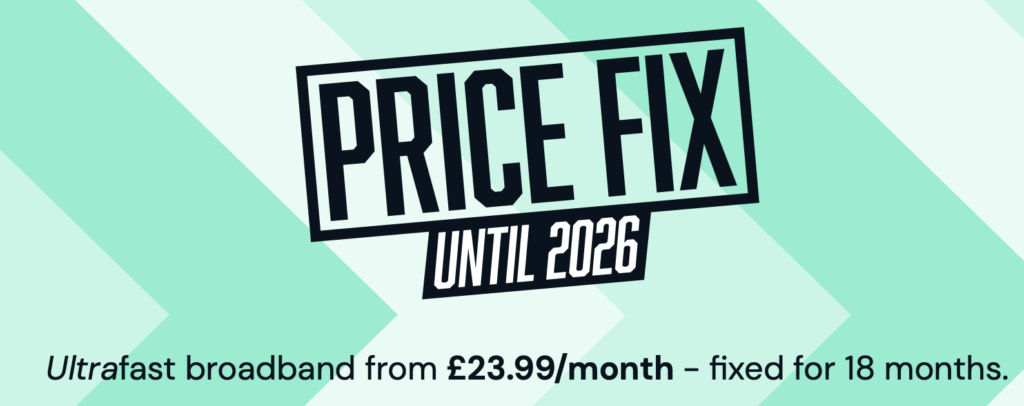
Introductory Periods — Many broadband services come with promotions where the first few months are at a lower cost from the remainder of the contract.
Vouchers — Many of the larger broadband providers will include Amazon Vouchers or other incentives for you to sign up to their service, which may be equivalent to cash. But do check the terms and conditions. For example, an offer by TalkTalk is for a £75 reward card you can use on Amazon, Tesco and other places.

Other Considerations
Reliability — This is tricky to pin down. As a general rule, FTTP services are likely to be more reliable as a technology as they don’t have as much risk of interference from weather or other services, however don’t forget that it’s not just the reliability of your service to the router, but also inside your home that matters. Your internal Wi-Fi is far more likely to be your problem if you have intermittent service issues on a regular basis. Look at how you can distribute Wi-Fi through your home, use a router which can automate channel selection, consider the Wi-Fi guarantees available from some providers, and where you can use physical Ethernet cables to connect computers to your router as opposed to Wi-Fi. See more details on our page about improving Wi-Fi.
Data Allowances — Most broadband services are ‘unlimited’ or ‘unmetered’ and the days of everyone wanting to ‘download the Internet’ are pretty much over with instant access. You may find mobile and satellite services have some restrictions, so we would say do check, but this is usually not a major issue. Obviously, don’t expect to run an office on a home broadband package.
Other Features — Into gaming? You may want to look at latency for your preferred game. Some technologies (and even some providers) may have higher latencies. ADSL will be worse than FTTP, satellite and mobile is usually higher latency. If this is an issue, ask on our forums and the community would be happy to advise.
Equipment & Wi-Fi Guarantees — Are you a technical person who wants to set up your own router and wireless networks, or do you want your provider to do this for you? Do you have a large home or one with thick stone walls where Wi-Fi signals may vary? Some providers will sell you managed services with Wi-Fi extenders and guarantees they will get you broadband coverage in each room of your house, but these packages do cost substantially more, so are more suited to those who aren’t technically minded.
 Test your broadband speed
 Follow us on X for the latest broadband news