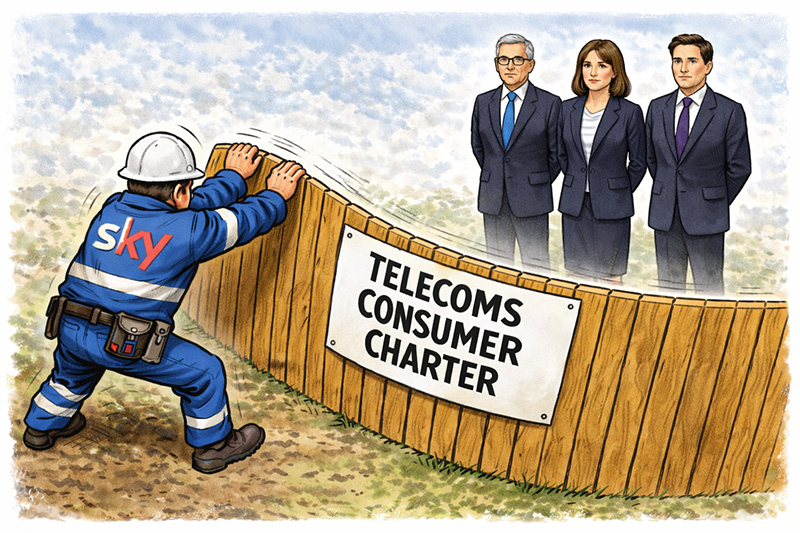
In February 2026, the Chancellor and Technology Minister launched the Telecoms Consumer Charter which was backed by the major operators.
“Broadband and mobile customers deserve to be treated fairly and not face sudden jumps in their bills.
Following action by this government, telecom companies have now agreed to end unexpected mid‑contract price rises“
Technology Secretary Liz Kendall (Source: gov.uk press release, 11/02/2026)
The charter is a voluntary scheme which was designed to promote consumer-interest practices by the major telecoms operators who signed up to it. Initial signatories included the major providers, with additional ones being added later. The current list includes: BT Group, Virgin Media O2, VodafoneThree, Sky, TalkTalk, KCOM, Community Fibre, and as of past week, WightFibre.
Sky Broadband is testing the boundaries of the government’s charter
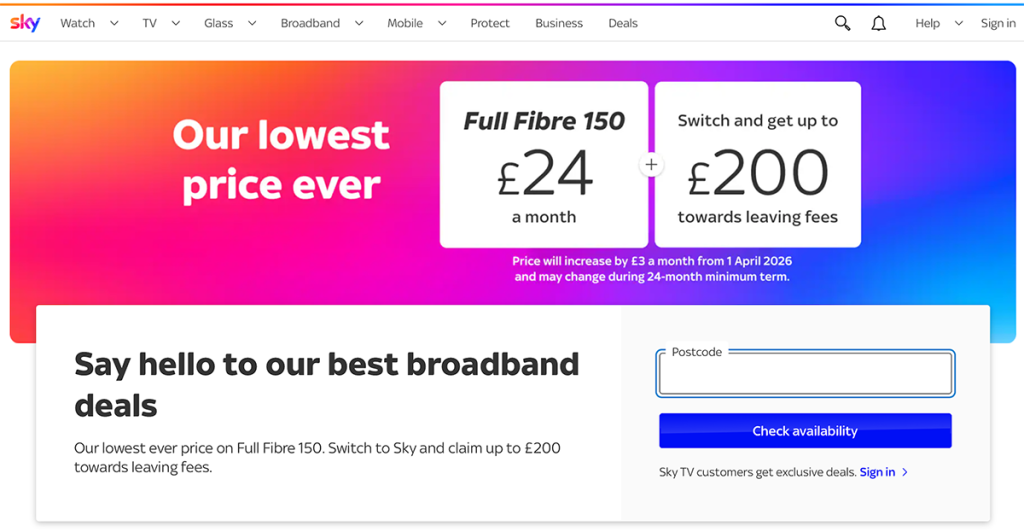
Sky Broadband recently changed from a “pounds and pence” model for price increases to a very vague term. In early March, their website included the text “Price will increase by £3 a month from 1 April 2026 and may change during 24-month minimum term”:
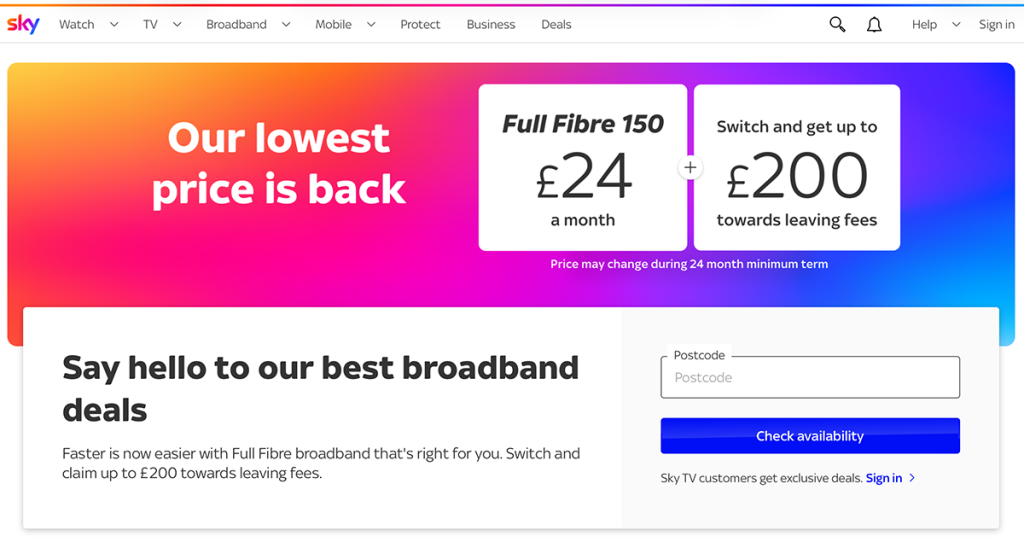
Since the beginning of April, it has removed references to a £3/month increase in April and it now simply says pricing “may change” during the minimum term (although April 2026 increases have now taken effect for existing customers, noting the headline price remains the same in these screen shots, it’s been normal for providers to update this to April the following year):
Does this mean the end of annual April price increases? — We don’t think so. It will mean that come April 2027, any increase will give consumers an opportunity to cancel their Sky service, but they’ll have to do this within 30 days of being advised of an increase. We suspect they will be betting on most users not cancelling service. This was no doubt the same gamble O2 made when it increased the prices of mobile packages in late 2025. This could mean consumers can end contracts in April each year without penalty, but how many will?
It could be argued that by removing references to a £3/month increase, it’s not mistakenly setting consumer expectations that an increase would ‘only’ be £3/month.
Sky Response — Sky have said there has been ‘no change’ to how they apply price increases and always followed the variable price increase approach rather than a ‘pounds and pence’ or inflation-linked model, so mobile, broadband, talk and satellite TV customers can cancel without penalty within 30 days of being notified of a price increase. They further state their belief that the approach is fully compliant with the Telecoms Consumer Charter.
DSIT Response — The government seems to agree with Sky that their position is compliant:
“Broadband and mobile customers deserve clear, upfront information about what they will pay. The Telecoms Consumer Charter was agreed with industry to protect customers from unexpected mid‑contract price rises, beyond the increases set out in their contracts.
Ofcom rules give Sky customers the right to switch provider whenever the prices increases”
Government Spokesman, DSIT
Let’s be clear, the right to cancel your contract for any increase beyond what was written was already there long before the Charter, so this is nothing new.
There is no clear upfront information about what you will pay next year.
The only benefit to consumers of this change is that any increase, no matter how small, allows you to exit your contract around March time without penalty.
If the net result of the Charter is less certainty for consumers, it begs the question, what is the point of it?
Is the Charter fit-for-purpose?
If this becomes the new standard, are other providers going to follow suit and move from fixed price increases to vague “we may change” wording to avoid being caught up by inflation-linked increases being barred and ‘pounds-and-pence’ increases being limited? Is this simply a way of reintroducing inflation-plus increases through the back door?
On our reading of the quotes responding to the O2 increases late last year, and around the launch of the Charter, it did not seem to be the communicated intent of the Charter to result in the removal of pounds-and-pence increases and turn them into vague and opaque increases which consumers can’t predict (even with the right to cancel on any such increase), but very clearly ‘pounds-and-pence’ outside of exceptional unforeseeable circumstances’.
The quotes from before and after the launch of the charter seemed to be a bolder pro-consumer message:
- customers will not face price rises “beyond those they signed up” for (Source: FT.com quoting Chancellor; Nov 2025)
- “move legacy customers onto the pounds and pence approach” (Source: gov.uk; Nov 2025 post-O2 issues)
- “end unexpected mid‑contract price rises“
- “All providers commit that, where a contract includes a mid‑contract price increase, the core subscription price that customers sign up to is the price that they will pay. Any exception to this is limited strictly to unforeseeable and externally driven events that materially affect the cost of providing services.” (Source: gov.uk; Official Charter text checked 08/04/2026)
We are moving from a transparent fixed increase, which was contractual (with the possibility of an increase beyond that with cancellation right), to a completely opaque likely increase, but without any quantum (still with cancellation right for consumers). This doesn’t provide consumers with any clarity.
The Charter essentially says “ISPs can have freedom to increase costs arbitrarily if they don’t specify any regular automated amounts (as long as the consumer has a right to cancel immediately on being notified)”. If this was the intention, the Charter and the press quotes could have been far better worded to reflect this.
Background — O2 pushes unexpected price increases
In October 2025, Virgin Media O2 announced mid-contract price increases to its mobile services. This increase was not communicated to consumers when signing up, and meant they were able to exit their contract early if they cancelled within 30 days of the notice.
This prompted a public rebuke from Ofcom, which criticised the change as “against the spirit” of the rules set out to protect consumers:
“We want customers to have certainty about their monthly mobile bills so they can plan their household budgets. That’s why earlier this year we banned unpredictable price rises linked to inflation and instead required providers to tell customers upfront in pounds and pence about any increases in their contract.
We are disappointed by O2’s decision. This goes against the spirit of our rules which are designed to ensure greater certainty and transparency for customers when they sign up.”
Ofcom statement on O2 price rises
Furthermore, the Chancellor of the Exchequer and the Telecoms Minister took up the issue the month after issuing a joint statement:
“We are asking you to reinforce your commitment to treating customers fairly, including by confirming customers under contract will not face price rises beyond those that they signed up to. We would also like you to take proactive steps to move legacy customers onto the pounds and pence approach for price communications with no impact on the timing of planned price increases.”
Joint Statement by Chancellor and Technology Minister
The Charter, which followed these increases, clearly stated the intention that consumers should fully understand their costs over the contract period at the point of signing up, unless exceptional circumstances apply where a provider may need to increase them. This change really makes us question, what is the point of the Charter?
 Test your broadband speed
 Follow us on X for the latest broadband news

It looks to me as Sky is just profiteering. As soon as my first year was up I have had price increases with no previous warning
I get it but I have a slight issue in that if you sign up to a contract knowing exactly what any increases are then everything is simple as you know the exact cost and time frame. If you committed to 24 months with 2 increases then so be it, you know cost and timing and after 23 months you choose renew, change or simply go uncontracted on a monthly base (but read your contract). Under the same contract term with Sky they can change the price at any time by notifying you. You have 30 days to reject it or it is deemed acceptance. Is that from date of notification or receipt? Sky use letters often vaguely dated which don’t always arrive – problem (Sky are never wrong!). So if you do so in time having worked out how to reject it (not always that easy from my experience) how much time have you got to exit before they decide to terminate? I have dealt with Sky on and off for TV more than a few times and it has never, ever, been an easy renewal/termination process – last time they acknowledged I’d posted their hardware back and then a week later insisted they had not received and tried to charge me. They were a nightmare and it never really had a conclusion. They now never write to me to become a customer again which probably says it all. Personally I still feel contracts should be truly fixed; x time and x cost and network permitting address transferable.
Just ban all increases mid-contract or better still only allow 1 year contracts.
This. If i enter a contract i expect to be just that a contract. I agree a price for a year, pay that price. Then either renew at an agreed higher price, or move somewhere else. We all do that with all sorts of things, car insurance, house insurance and all sorts. These scumbags should be no different in my mind, and particularly Sky. They have a very very long history of ripping people of for years and years on end.
It was interesting (but unsurprising) to read a forum thread about the difficulty some Sky customers have had in exercising their right to cancel their Sky Broadband contract after the price rise announcement – many Sky customer service agents seemingly being unaware of this possibility.
I’d agree that inertia and the faff factor will probably mean most Sky BB customers just stay put.
A contract should stay the same until renewed. I don’t understand how it changed to different pricing half way through a contract. Or why. I have been with the same provider for more than five years and so far I’ve never had a price increase, in fact they have told me that the price of broadband has actually dropped. To that end I will stay with them.
My broadband with Youfibre does NOT increase during the fixed term.
My mobile with Lebara does NOT increase during the 12m term.
It can be done.