
Ofcom has published a new consultation on splitting up the ‘upper 6GHz band’ (6425–7125 MHz) to allow it to be utilised by both Wi-Fi and mobile at the same time, but in different locations. By enabling ‘prioritised spectrum sharing’, Ofcom says it will significantly increase the spectrum that is available for both services, which will help with meeting demand from data-hungry devices. The proposals will see ‘Wi-Fi priority’ in the bottom 160MHz of the band (6425-6585 MHz) and ‘mobile priority’ in the upper 540MHz (6585-7125 MHz).
The current plan is that low-powered Wi-Fi devices will be able to use the portion of the 6GHz spectrum by the end of the year, with mobile networks getting access later on. Wi-Fi devices would need to be in a standard Wi-Fi device to access-point system and would be under the control of an Automated Frequency Coordination (AFC) database to access the ‘mobile priority’ part of the band. This will help ensure that interference is avoided in this area of the spectrum. The way the AFC will work is detailed in a separate consultation. The technical requirements proposed for Wi-Fi under AFC contorl is as follows:
- Standard Power Wi-Fi access points and fixed client devices shall have a geolocation capability and shall access an AFC system to determine the available frequencies and associated maximum transmit power levels at their location prior to transmitting.
- Mobile client devices operating in the 6 GHz band under the control of a Standard Power access point shall not be capable of initiating a network or connecting directly to another client device.
The use of the upper 6GHz band would be focused on serving densely populated areas where there is high demand, and is likely to see use from future 6G services on the mobile side, possibly from 2030.
Separately, Ofcom has also decided that the ‘lower 6GHz’ band (5925-6425 MHz), which is currently available for low power and indoor Wi-Fi will be available for high power devices (up to 36dBm) and outdoor Wi-Fi too. This could help increase capacity in locations like train stations and stadiums.
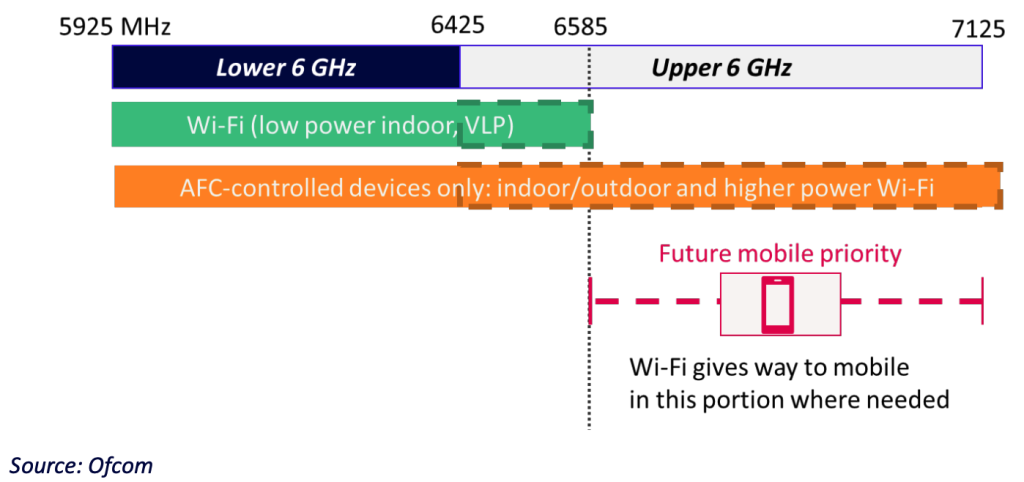
It’s hoped that in the future, band sharing can be further improved by other mechanisms to avoid spectrum conflicts – namely ‘enhanced sensing’, which is being developed as part of the European harmonisation process. This is expected to work by sensing a mobile network signal in a specific channel, and moving to a different channel if one is detected. This could also mean that mobile base stations will transmit a signal specifically designed for Wi-Fi equipment to detect, such that they can then easily avoid using those channels.
AFC will also help protect other users of the band, which includes approximately 500 fixed links utilised by energy and financial institutions, by identifying that the spectrum is in use in that location. Other users also include Fixed Satellite Services (earth-to-satellite), some earth exploration services, and military use by the MoD. AFC is not currently planned to protect these services, as Ofcom analysis and work by the European CEPT SE45 working group have determined that it is unnecessary.
 Test your broadband speed
 Follow us on X for the latest broadband news

Leave a reply