The push to get full fibre as the default broadband technology for new build properties looks to have levelled off at around 98% coverage, and with legislation allowing builds to skip making FTTP available if the costs are high it seems unlikely we will see anything much closer than 98% across the UK as a whole.
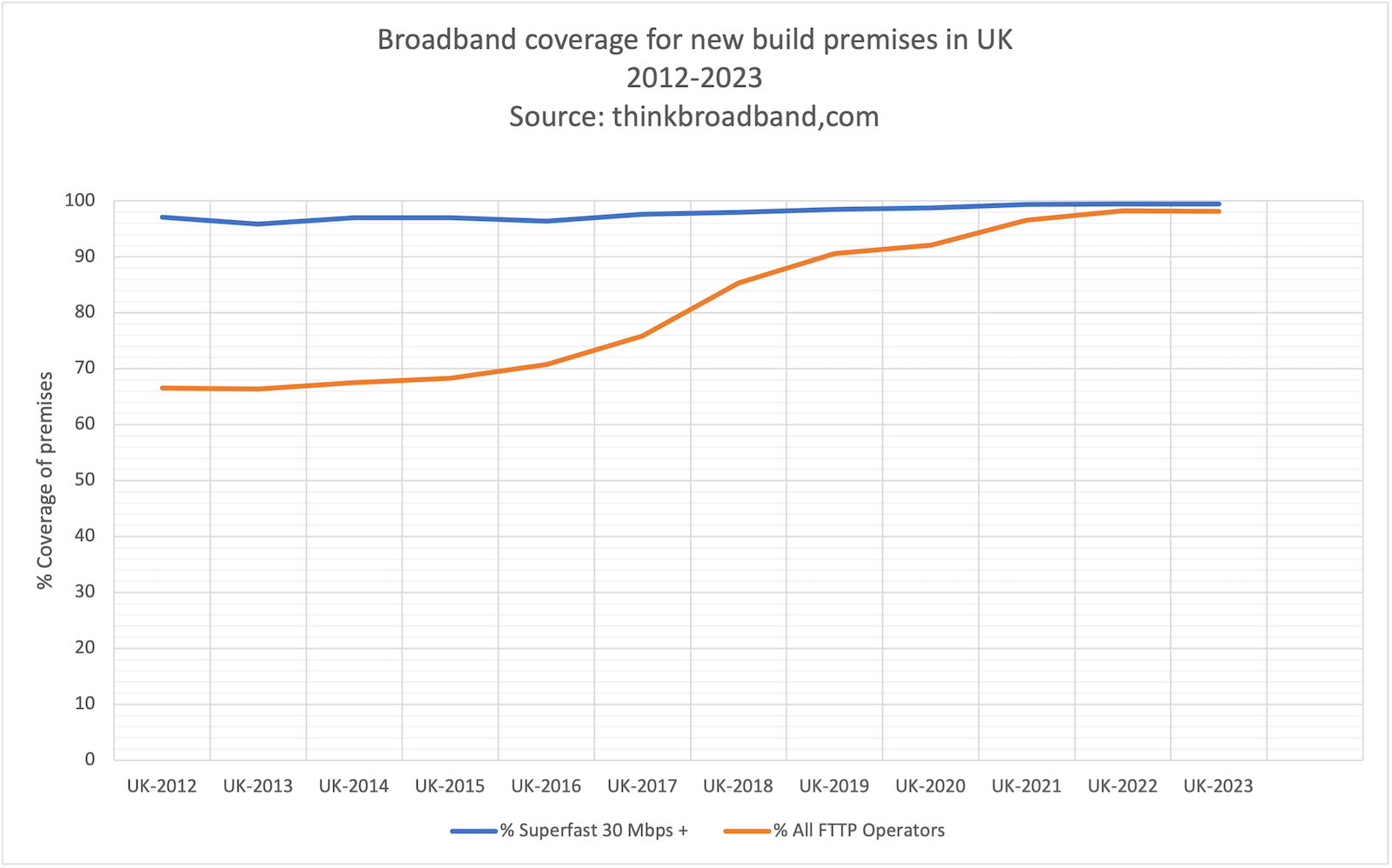
Levels of superfast and full fibre coverage in UK new builds since 2012
The big gap between Openreach FTTP coverage and the figures once you look at all the FTTP networks is mainly down to providers such as OFNL and Fibre Nest. In the case of these two networks we invariably see no Openreach network at all, be that copper or fibre. We have revamped the columns we show in the new build coverage table to make it easier to spot the most important figures.
|
thinkbroadband analysis of Superfast and Full Fibre Broadband Coverage across the UK, Scotland, Wales and Northern Ireland and English regions for new build premises figures 20th June 2023 |
|||||
|---|---|---|---|---|---|
| Area | % superfast 30 Mbps or faster |
% Virgin Media Cable |
% Openreach or KCOM FTTP |
% All FTTP Operators |
% Openreach FTTP and one or more other FTTP Provider |
| UK 2023 32,572 premises | 99.5% | 1.7% | 87.7% | 98.1% | 14.8% |
| UK 2022 163,104 premises |
99.5% | 2.3% | 82.0% | 98.3% | 16.8% |
| UK 2021 216,255 premises |
99.4% | 4.3% | 81.9% | 96.6% | 17.5% |
| UK 2020 195,083 premises |
98.8% | 5.4% | 78.1% | 92.1% | 17.5% |
| UK 2019 237,334 premises |
98.5% | 9.7% | 77.2% | 90.6% | 20.2% |
| East of England 2023 3,162 premises |
99.7% | 0.3% | 86.7% | 98.8% | 1.5% |
| East of England 2022 16,459 premises |
99.3% | 1.3% | 70.2% | 98.4% | 13.8% |
| East Midlands 2023 1,485 premises |
99.7% | 0.6% | 78.9% | 98.9% | 3.4% |
| East Midlands 2022 5,750 premises |
99.8% | 4.7% | 81.8% | 97.6% | 13.4% |
| London 2023 7,941 premises |
99.3% | 2% | 83.7% | 97.3% | 33% |
| London 2022 29,238 premises |
99.5% | 1.6% | 82.1% | 98.6% | 40% |
| North East 2023 713 premises |
97.6% | 0% | 89.8% | 96.9% | 13% |
| North East 2022 4,826 premises |
97.6% | 1.9% | 73.3% | 95.7% | 13.2% |
| North West 2023 3,236 premises |
98.9 | 1.9% | 94.6% | 97.3% | 12.7% |
| North West 2022 17,488 premises |
99.8% | 0.9% | 90.1% | 98.8% | 13.6% |
| Northern Ireland 2023 491 premises |
100% | 3.9% | 99% | 99% | 0% |
| Northern Ireland 2022 2,289 premises |
98.8% | 2.3% | 97.8% | 97.8% | 0% |
| Scotland 2023 2,960 premises |
99.7% | 1.7% | 96% | 99.5% | 8.8% |
| Scotland 2022 14,978 premises |
99.7% | 3.6% | 87.2% | 96.6% | 15.7% |
| South East 2023 2,848 premises |
99.3% | 0.7% | 84.4% | 98.6% | 28.9% |
| South East 2022 17,767 premises |
99.7% | 2.2% | 74.6% | 98.4% | 20.3% |
| South West 2023 3,642 premises |
99.7% | 2.3% | 90% | 98.5% | 9% |
| South West 2022 16,886 premises |
99.8% | 1.6% | 82.3% | 98.8% | 11% |
| Wales 2023 1,045 premises |
99.8% | 0% | 93.5% | 99.3% | 0% |
| Wales 2022 6,063 premises |
99.2% | 2.4% | 86.2% | 96.2% | 6.6% |
| West Midlands 2023 2,953 premises |
100% | 1.3% | 91.4% | 98.5% | 3.1% |
| West Midlands 2022 15,722 premises |
99.8% | 2.7% | 81.6% | 99% | 11.7% |
| Yorkshire and Humber 2023 2,096 premises |
99.6% | 4.3% | 77.1% | 96.7% | 4.7% |
| Yorkshire and Humber 2022 15,638 premises |
99.6% | 4.3% | 77.1% | 96.7% | 4.7% |
The 2023 premises counts will be low because while we are in June 2023, the ONS postcode data file only includes postcodes for Jan, Feb, Mar and Apr 2023 and was released 12 days ago. So we’ve only just started processing the latest 3 months and due to the fun and games in determining which broadband provider(s) are serving a postcode and how many properties exist even the 2022 figures are subject to change.
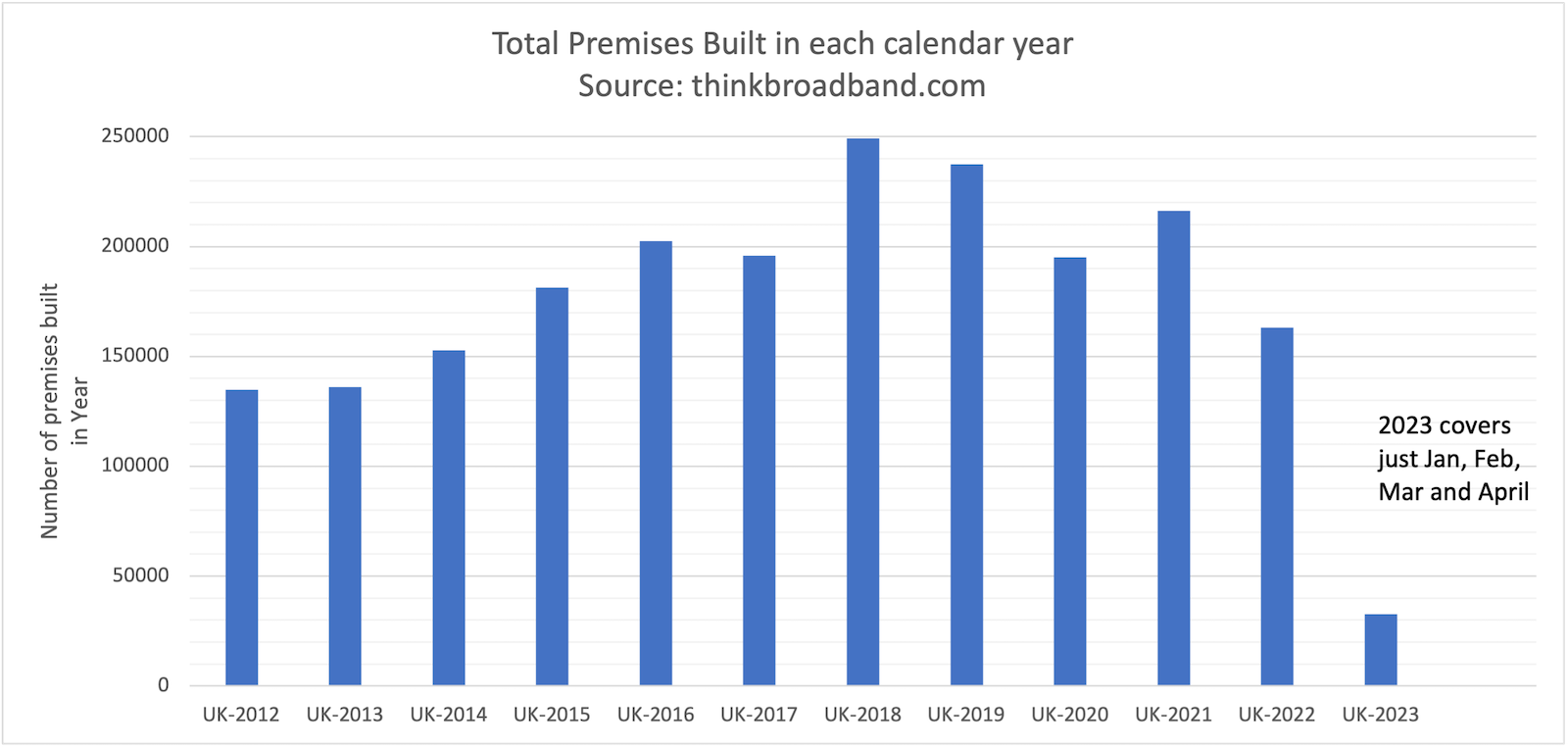
Volume of new build properties built each year since 2012
In our dataset for new build properties we don’t differentiate between homes and business premises, but the vast bulk are fully residential postcodes. The following table of new build activity since 2012 gives an idea of the scale of home building across the UK which seems to have peakedin 2018. Our figures are based on calendar year, i.e. Jan to Dec whereas generally figures from the Government will align around the financial calendar of Apr to Mar. The impact from financial crisis and high mortgage interest rates is not going to show in our figures for another year at least, unless developers totally shut down their activities. The dip of building activity due to the Covid lockdowns in 2020 is still visible.
 Test your broadband speed
 Follow us on X for the latest broadband news




FTTP is fine with new builds as long as people have a choice on their provider, I have seen that some home builders dictate what people can use as they have a deal with a certain provider. That also happens with some housing associations as well.
We have had new builds around here and no FTTP, now that Open reach is extending in the city it may be easier, but I feel new builds should just have the ducts and let people choose, certainly if they have choice of different networks.
@Zyborg, you know that isn’t how it works. The cable in the duct is a tiny part of the installation and for providers to build networks they need a business case. The builder is only likely to give funding for one option – if that is OpenReach then the householder would have choice through wholesale. If it is one of the others then generally only one option will be available. Other providers will be less likely to also install as business case would be hard due to the competition already there. One infrastructure provider is the most likely outcome for many.
One of the big differences in USA broadband is the lack of choice in the states due to the ISP and physical infrastructure being the same. As we have in the UK with cable.
If FTTP alt nets survive and don’t amalgamate then the whole UK will be poorer. Thankfully some signs of this with CityFibre being a neutral network and the likes of Toob now working with CityFibre as well as running their own ISP.
@ian72, I did not say put fibre or cable in, I said just make sure the ducts are there for people to have the choice if there is a choice.
@jchamier, i can’t see how the UK will be poorer if Alt net survives, we need competition, Openreach have had it too good for years.
@Zyborg Ducts make no difference to the availability of suppliers. In general a housebuilder will work with a supplier to deliver connectivity. It is then down to the market as to whether any other suppliers can build a business case – the ducts being there are a very minor part of delivery as it needs all the infrastructure built to get from the edge of the premises back into the suppliers network – that is not trivial and is only going to happen in areas where a good return on investment is likely.