Background on broadband advertising — Back in July 2024, Ofcom announced it was to ban inflation-linked price increases on consumer broadband packages from January 2025 and following this many operators have moved towards a fixed ‘pounds and pence’ increase. BT pre-empted this change by announcement it would do so in January 2024 with various others following suit. Inflation-linked increases have been in the headlines with high inflation rates resulting in 8% broadband price increases from many; Sky Broadband increased its prices by up to 13.5% in April 2024.
Since the changes by the major operators, we no longer see “CPI+3.8%” or similar increases with the level of inflation being unknown but text such as “Prices rise each year on 31 March by £3.24/month” and similar texts. This is definitely a win for consumers as they know exactly what to expect in terms of price increases, but it comes with a risk that the increase may be higher in some cases (Vodafone being case in point) as providers hedge their bets on their cost base inflation (but at least they are probably better equipped to do that than the average consumer).
Of course, there are other providers who will still guarantee no mid-contract price increases at all (something we’ve said we’d like the new government to adopt as policy) including many alt-nets as well as long term challenger Zen Internet)
ASA Regulation — In parallel with Ofcom’s anti-inflation policies, the Advertising Standard Authority (ASA UK) changed its view on how mid-contract price increases are advertised in December 2023 following an earlier announcement the previous June and a consultation prior to that. In that, it provides guidance about how such increases should be communicated. In its document it provides an example (remember this doesn’t consider Ofcom’s change on references to inflation):
£48/month until April 2023
Monthly price will increase each April by the Retail Price Index rate of
inflation published in January + 3.6%
(the above text should render approximately in proportion of how the ASA specify on page 7 of the above document; the text below is a bit smaller)
Specifically, in the guidance, it provides examples that make it clear that text you have to hover over to get more details, or small print far away from the main text would be likely to be considered misleading. It also specifically states “An ad is more likely to comply when information indicating the presence or possibility of a price rise has equal prominence with the price claim”.
ASA hits out at BT, EE, O2, PlusNet, TalkTalk and Virgin Media — As part of its work on mid-contract price increases, the ASA issued similar rulings against the six telecommunications companies. Although there are some variations, it highlights the confusion that companies face when promoting products on their own website. We won’t repeat through each of the rulings, however the EE ruling stated:
“Ad description
[.. ]
Text for each of the packages stated the download speed, cost and length of the contract. Smaller text directly under the price stated, “Increases 31 March”.
At the bottom of the page, under the subheading “The legal bit”, text stated, “On 31 March each year the monthly price shown for your broadband plan will increase by £3 […] Out of bundle charges will increase by 5%. See ee.co.uk/prices-explained for details. All prices shown are in contract [sic] prices. Please note the cost of other services you take from us may increase or decrease while you are an EE customer”.
[..]
Assessment
CAP Guidance stated that the presence of and, if applicable, the nature of mid-contract price increases, were material information that consumers needed in order to make an informed transactional decision. Consequently, marketers were required to ensure that advertising for services that included mid-contract price increases included such information and that it was presented clearly and prominently. The guidance also stated that asterisks or links, which linked to information more than one ‘step’ below the price claim, were unlikely to give adequate weight to the significance of material information. The ASA assessed the ad in question against the Code.
[..]
We also assessed the text near the top of the broadband package webpage, which similarly stated that prices would increase by £3 each year. We acknowledged EE’s comments that they had included specific information about the price rise amount above the individual package details, to try to make clear to consumers that all packages were subject to the price rise. However, we considered that the information was not as prominent or as large as the information for each broadband package. We also noted that it was not located close to the price claims, which we considered did not give adequate weight to the significance of such information. The text near the top of the webpage was located underneath a box which contained information on EE mobile phone contract savings. We considered that this text was easy to miss due to its size and positioning under that information. We also noted that the information concerning the price increases did not remain visible as the webpage was scrolled down, meaning that the packages could potentially be viewed while the specific price increase information was not visible on-screen.”
ASA ruling against EE
It can be difficult to quite understand the advert from the full text description and we would welcome the ASA including screenshots in its rulings.
The current EE website looks like this (after you put in a postcode). The page includes two segments which we’ll show separately for simplicity (we have highlighted in red the references to price increases):

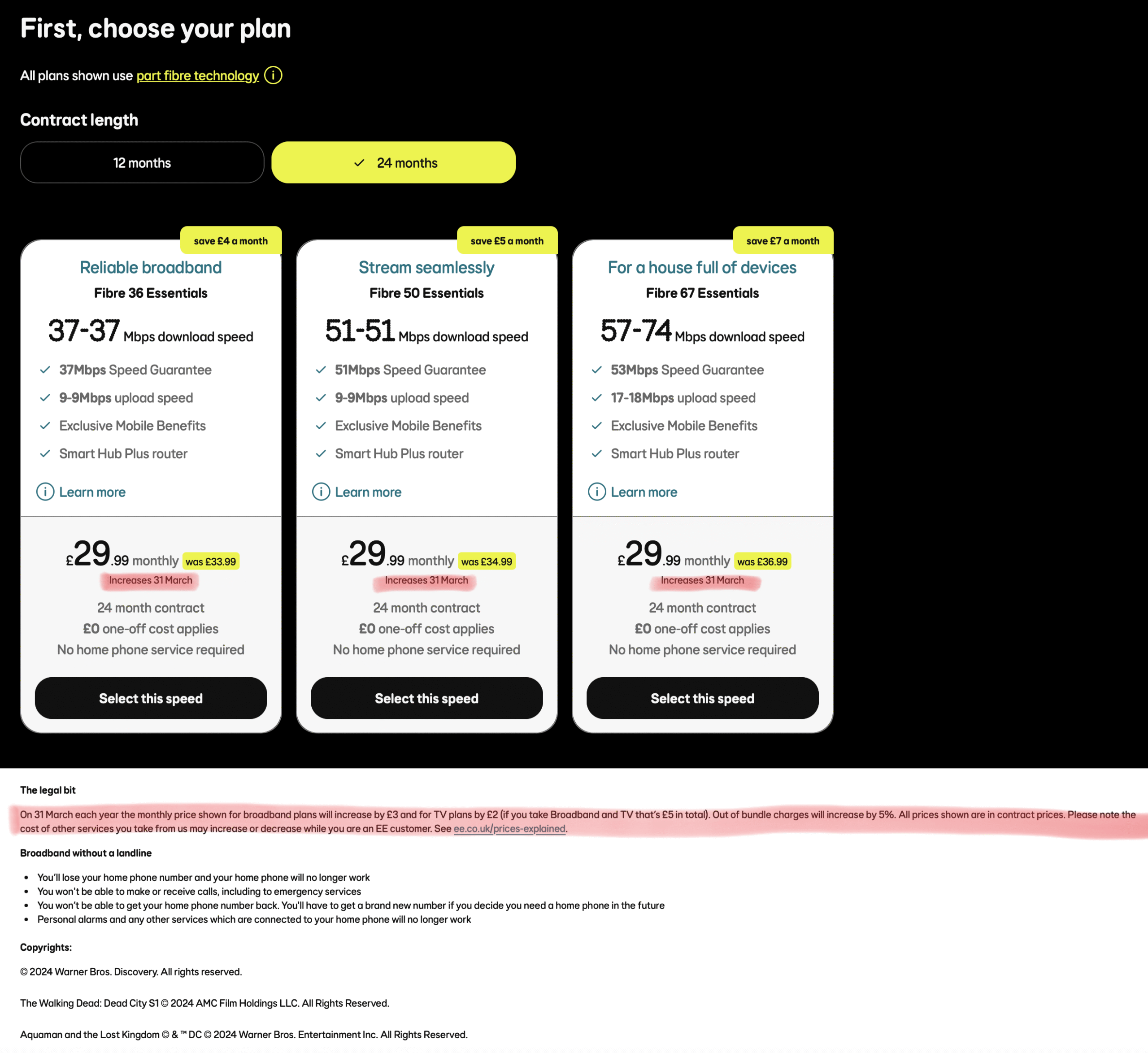
We think that to an average user, it’s quite clear that there is an increase at the end of March. The text is considerably smaller than the reference to a 24-month contract. We would prefer if this increase was clearer. In the box at the top it is clearer than near the packages. but we know users will not read everything but jump to the list of packages. Also the amount of increase is not immediately visible, and on a 24-month contract there would be two increases so it should say “every 31 March”. Is the ASA right to take the company up on this? Probably yes.
A similar extract from the Virgin Media website is shown below:
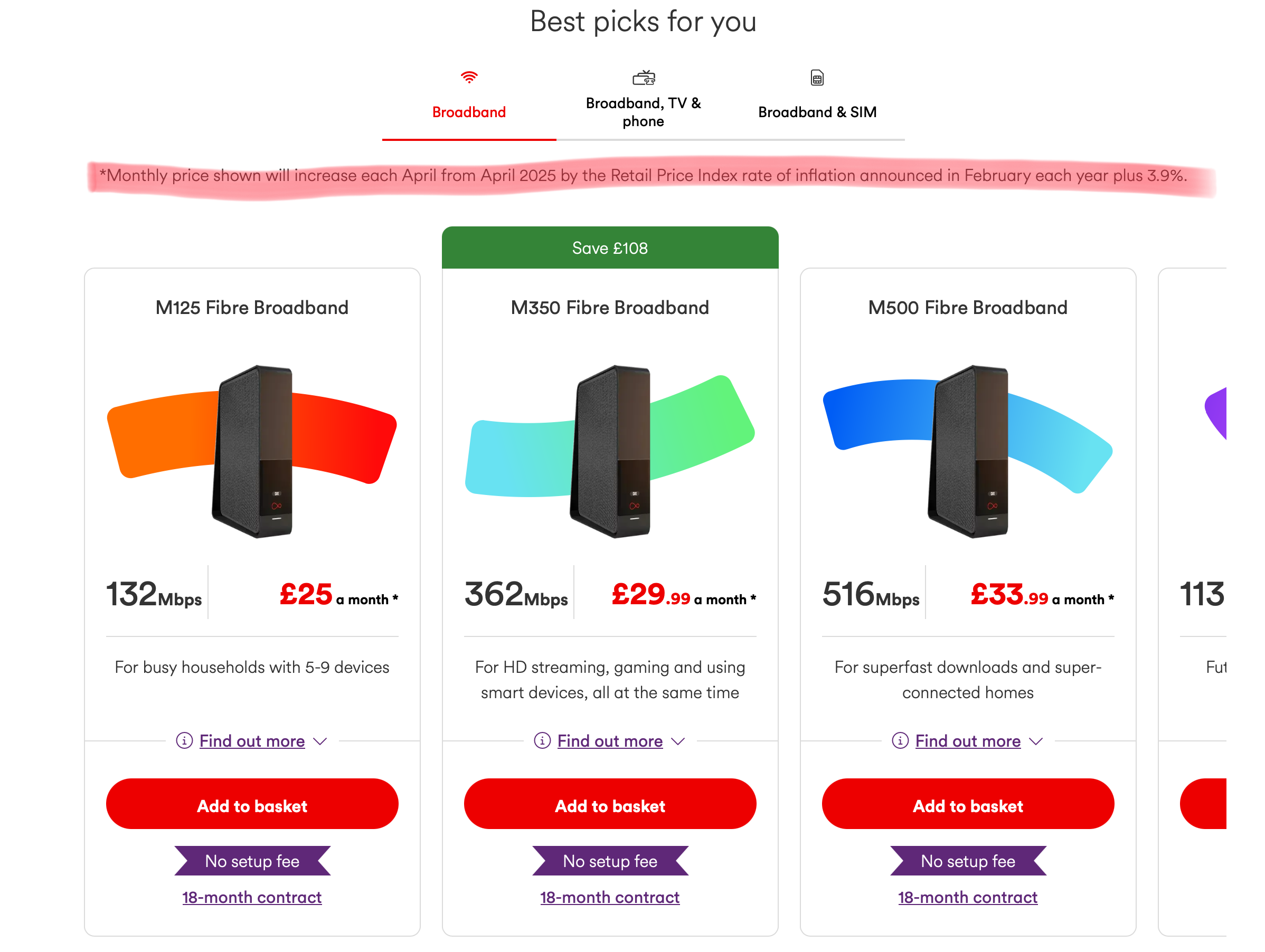
Virgin also includes second references with a second asterix as the bottom of the page above “The legal stuff” with a reference above the packages. We think this is even less clear as the information is completely away from the price and contract period.
In the end, all the major providers are trying to push the rules to the limit to maximise revenue whilst staying below the ASA’s radar. It is helpful to see these rulings published at the same time rather than targeting a single company. The O2 ruling is in respect of mobile price plans rather than broadband. Some of the rulings refer to colours so may be slightly different from the above in respect of specific texts, however all share the same theme around user confusion.
We are updating our ISP listings system soon to try to make comparisons better taking into account increases in the calculations to make it even easier for you to compare services.
 Test your broadband speed
 Follow us on X for the latest broadband news

Leave a reply