We have had time to look at the Cyberpower BR700ELCD UPS and have added a short review to our guide to provide information around the Digital Voice/Voice over Broadband roll-outs that will eventually see the old PSTN landline network switched off.
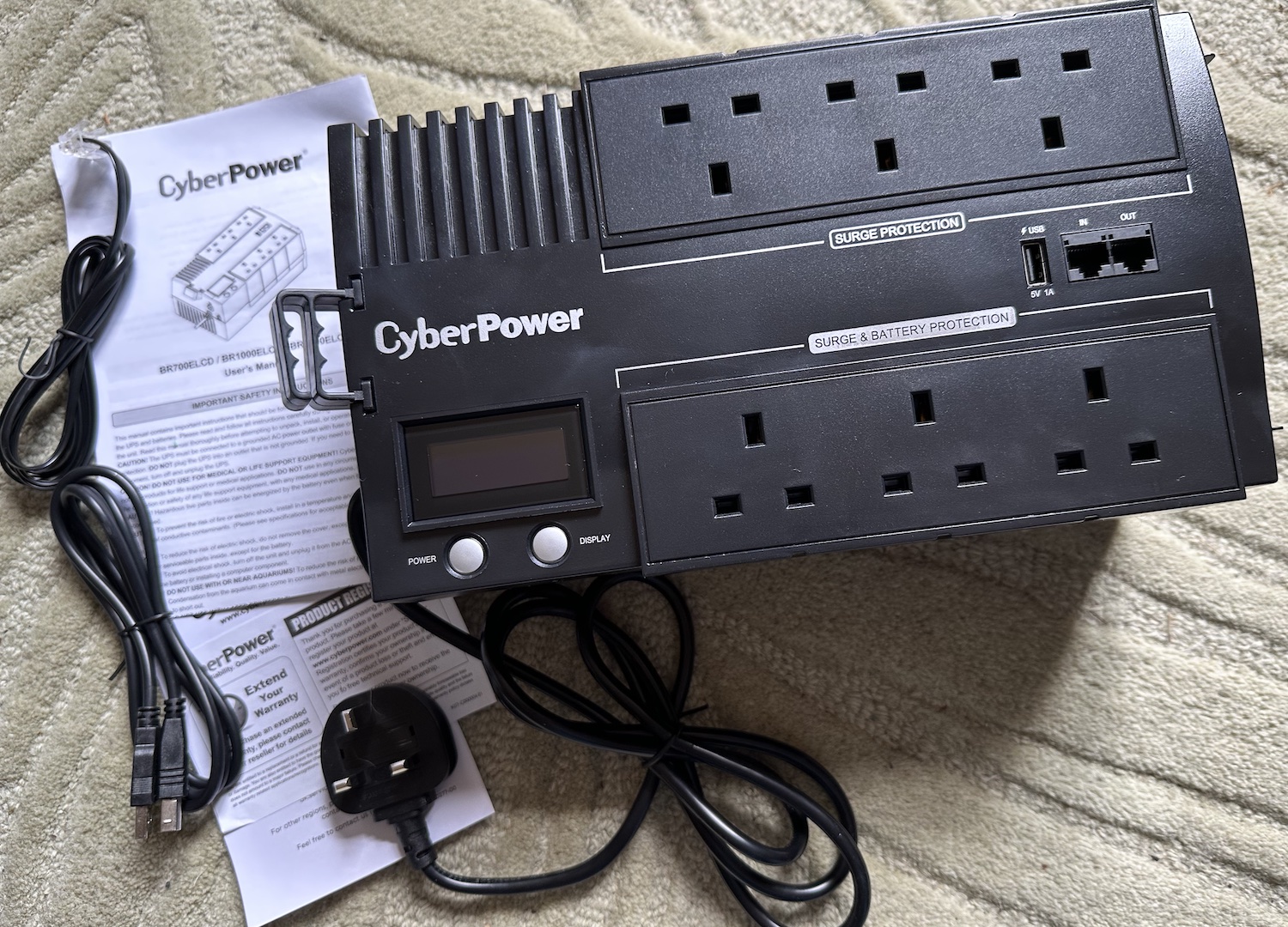
The Cyberpower BR700ELCD and what you get in the box, i.e. RJ11 lead and USB connector
The CyberPower BR700ELCD provides six UK plug sockets, there of these are UPS protected, and three just have basic surge protection.
Three UK plug sockets means it can power a fibre ONT, broadband router and DECT cordless base station, therefore keeping your Wi-Fi and telephones working in a power cut.
 Test your broadband speed
 Follow us on X for the latest broadband news



It would be good to have some reviews of DC UPSes with 12V outputs, since these could connect directly to router/ONT and avoid the whole inverter overhead.
I was thinking of getting something like this for my NAS, but I have read bad reviews about Cyberpower, also not sure if it is compatible with my Nas.
@candlerb – We tested a couple earlier this year – https://www.thinkbroadband.com/guides/how-to-stay-online-if-uk-experiences-rolling-power-cuts – TalentCell one is a bit better from mye xperience to the Eaton big name one – is there something specific you’d like us to test on those?
@zyborg47 – What compatibility are you referring to? Not delivering enough power, or something else?
@zyborg47 I have one of these APC BE700G-UK Back-UPS 700VA, and it runs my QNAP NAS fine. It also covers my 2 Modems and Router amongst other pieces of kit. It was originally purchased to smooth out brown outs on the mains. These have since stopped years back, but it’s still installed and working. In the many years I’ve had the unit, I’ve only had to replace the battery once. Yes, some people don’t like them and prefer a DC unit, but hey, horses for courses 🙂
@Seb, I don;t know if the NAS will recognise the UPS via the USB as that is the way it would shut the NAS down if the battery got too low before the power returns. I will have to look at ther NAs website. Saying that we only have powercuts once in the blue moon.
@Adduxi, I had aPC years ago, used a serial port, so that shows how long ago, it was fine, but the battery died and it cost more to get a new battery than a new UPS. It was given to me, found in an office block that was being demolished
I meant I had a APC years ago, not a PC 🙂
I use a number of PowerWalker UPSs. The company offers a range of sine-wave output units, which are kinder to supported equipment. Many UPSs on the market output a modified square wave when the grid power fails. Like most units they have a USB interface, which is aimed at an attached PC or NAS(i.e. the attached device is intelligent) but don’t allow communication with devices such as routers, modems etc. The communication allows the supported device to close down safely. These units can be pre-set to close down at a specified battery level & auto-run a weekly battery test.
I’ve been running this in my home lab setup, it’s powering a small tower PC and a Mirktoik router and switch and gives me around 15-20 run time, for the price its a really good value
I’m particularly intrigued by your plan to replace the lead-acid battery with an LFP unit and I wonder how the UPS voltage control electronics will cope with what I assume to be somewhat different voltage discharge characteristics. I look forward to seeing how you get on with the substitution and how it performs.
My interest arises because I have an APC Back-UPS 850 which I use for controlled powerdown of my desktop and NAS in the event of a power outage lasting more than 5 minutes; it’s comparable to the reviewed unit.
In terms of keeping the broadband and VOIP service going, I’ve taken a different approach and am using a Talentcell SL3400* Lithium-ion unit. This has 4 12v outlets 2 of which power the ONT and router, 1 9v outlet and 2 usb A outlets 1 of which powers the ATA. I have twice unplugged the unit’s power supply and on both occasions it lasted in excess of 8 hours, so would provide considerable coverage in conjunction with the laptop; more than enough for all but situations like storm damage, when there would certainly be even bigger problems.
Good to hear the TalentCell is decent. I rather had my doubts since they include a 2A PSU but would need about 5A to run the rated 4A output while charging the batteries at a decent speed after power is restored. Out of the box it clearly does not meet the claimed specifications.
I actually have a couple of no-name 12V 2A from Amazon I use to run some LED strips in the hallway on a dimmer, as emergency lighting. As well an iPower IP2100-12G running the ONT. Router is using a PoE adapter off my network switch which is on a CyberPower CP900EPFCLCD (though that estimates only 15min at 162W).
They are just ‘sockets’, not ‘plug sockets’. Why don’t we call ‘plugs’ ‘socket plugs’?!