6G Internet who are the retail ISP for IX Wireless is rolling out in places like Bolton and as we were in Manchester for Connected North this week, we thought we’d pop over to see what the fuss and protests are about.
View of the top of an IX Wireless / 6G Internet mast
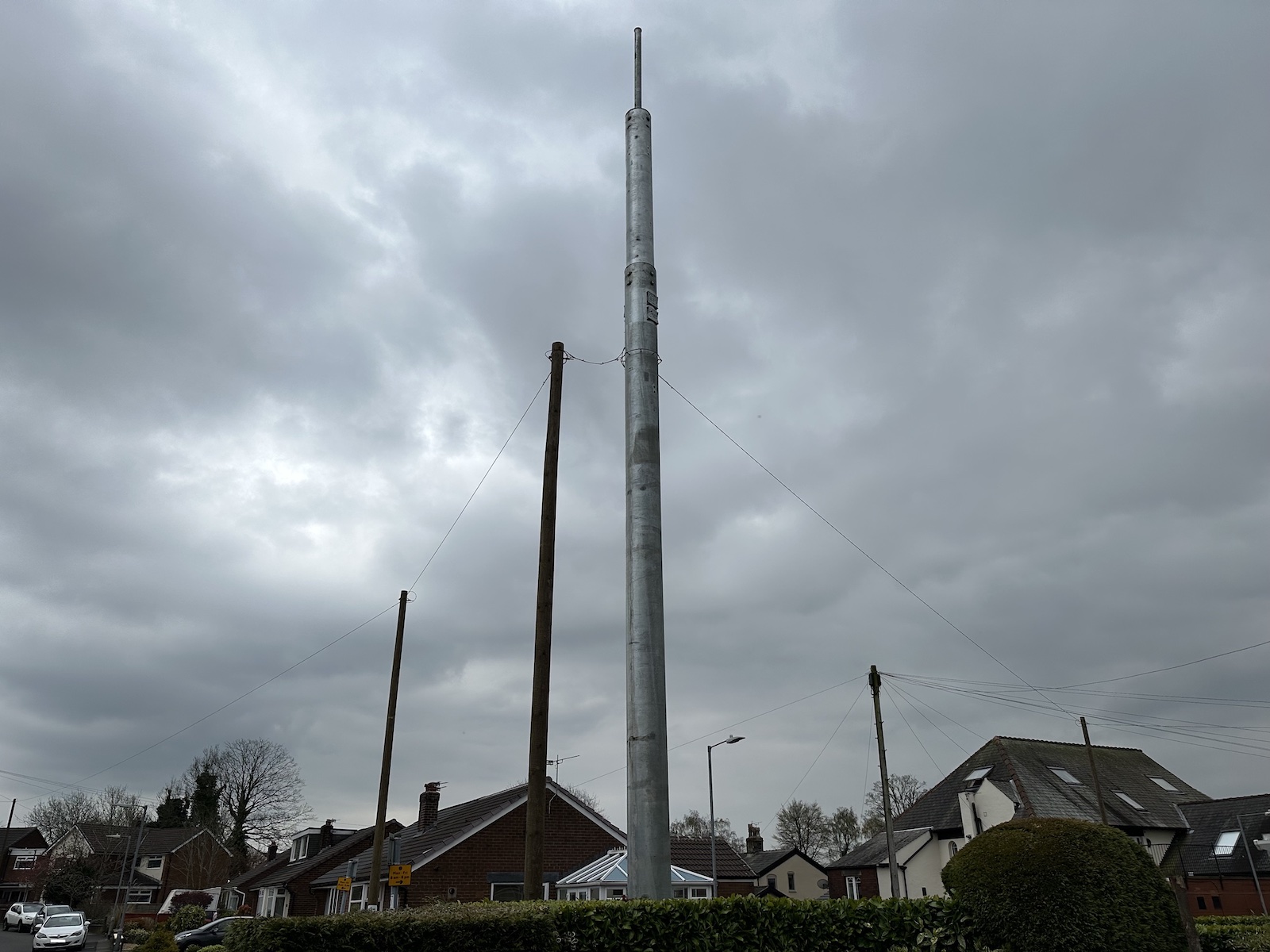
There have been protests locally around the masts appearing, with the metal masts being compared to rockets and as the pictures we took show the metal mast that will house the wireless antenna is very large compared to the telephone poles. One aspect that was a bit of a shocker is the size of the cabinets which is more akin to the size of the active cabinets used in FTTP roll-outs when hundreds or thousands of fibres are terminating at them. The wireless standard thought to be in use is the 802.11axR2 standard which is seen as an improvement on 802.11ac and is more commonly known as WiFi6 or WiFi6E.
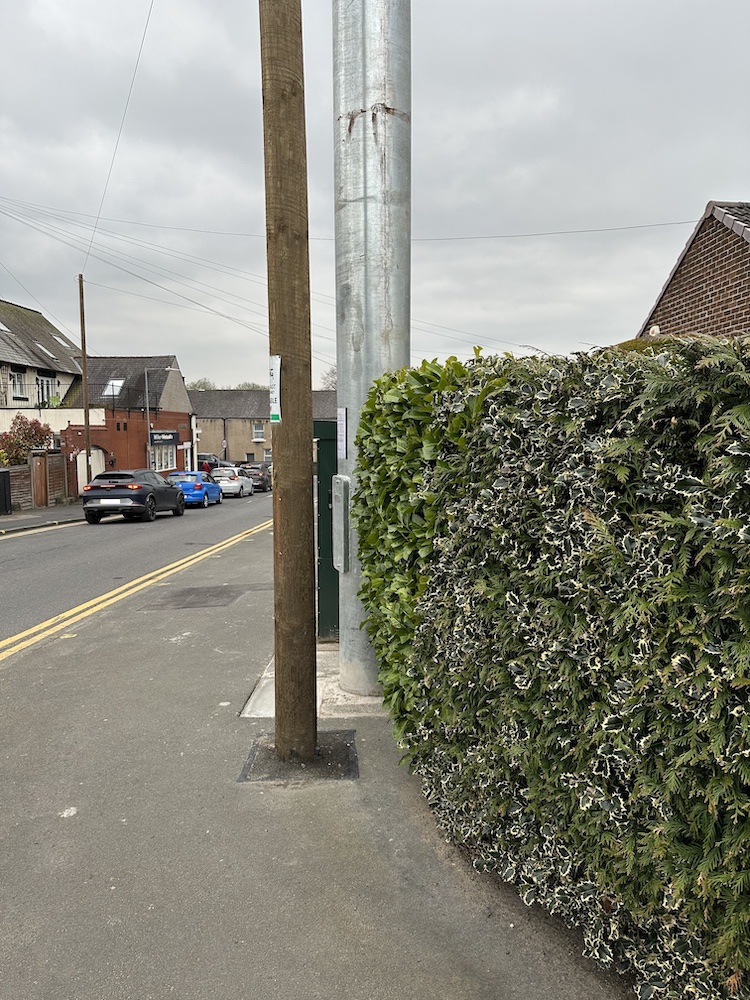
View of the base of an IX Wireless mast and its size compared to a standard telephone pole
The topology is such that we only spotted one of the metal masts in the Lea Gate Close area with the single bundle of fibres heading off into the distance. A fibre could be seen running along Bolton Road and Bradshaw Brow with long runs between tall telephone poles, there was a gap in the run where the route needed to pass through a tree with the fibre coiled at the top of the nearest pole. It is worth pointing out that we saw no evidence of fibre break-outs that would allow for expansion to FTTP i.e. the long runs seem to be linking each mast back to the central office.
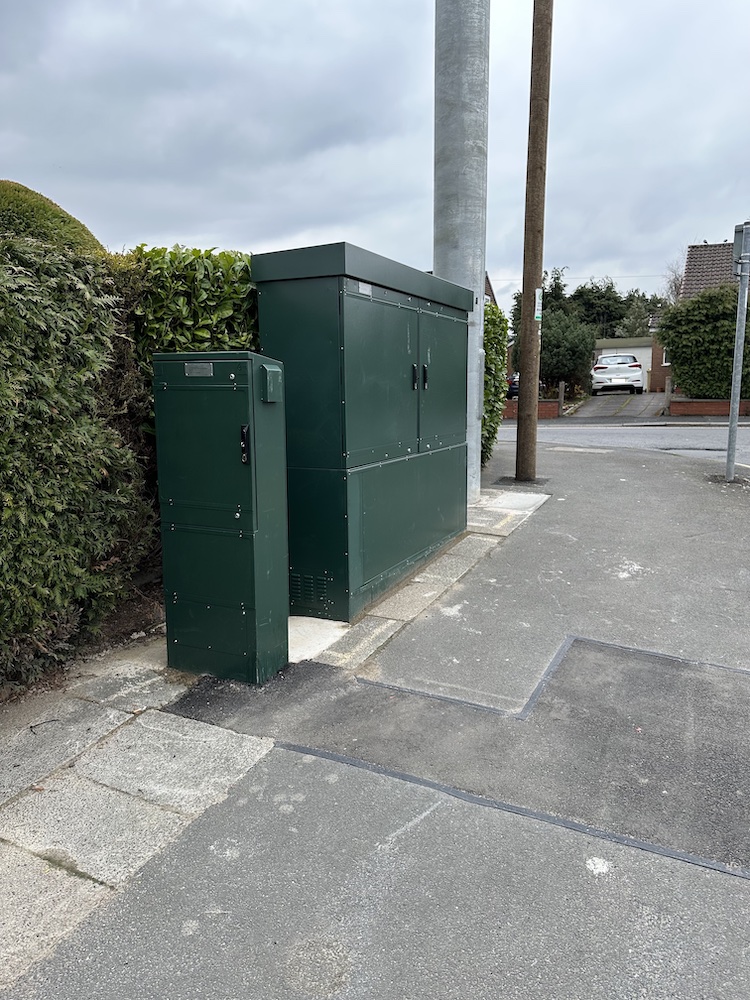
Image of 6G Internet cabinets, pole and mast on pavement
Unfortunately, almost all the poles we could see carried 6G Ultra-fast Home Internet available now and none of the postcodes in the area we went are actually able to order the service. Our expectation for coverage from each mast is something like 250 metres, but so long as power levels are managed correctly, better antenna may reach further.
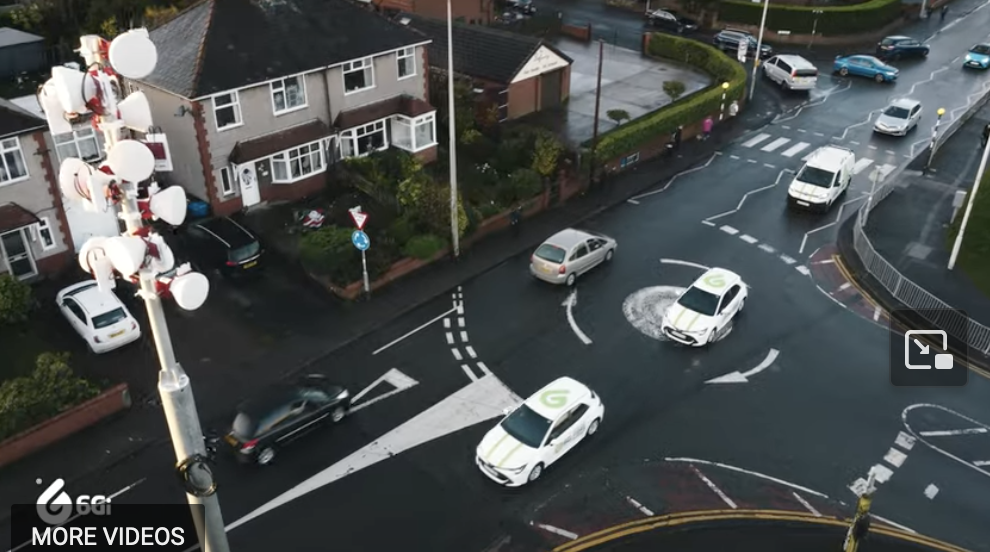
Screenshot from promotional video for 6G Internet service
The top of the pole in Lea Gate Close is unpopulated, but a promotional video of the 6G Internet service includes what may be a render of what a populated pole is going to look like. With more time in Bolton and some geo-location research, we could probably find the junction and confirm if a mast is present and looking live.
We also noted some fenced-off equipment indicating CityFibre has been working in the area, and it does look like CityFibre is on the way, in addition to the existing Virgin Media cable services and VDSL2 over the Openreach network. So the location of this mast is definitely not underserved. Phone lines in Lea Gate Close were largely delivered with some ducting in the street and lines going up existing poles to drop to each home, but PIA means CityFibre could roll out and use the existing poles for their service.
A campaign is underway to get the permitted development rights tightened to try and stop roll-outs like this by forcing operators to seek planning permission before the masts appear, rather than as now a notice gets attached to mast and poles after installation and complaints become retrospective.
Objections to new broadband infrastructure are not uncommon and the relaxation of permitted development rights is one of the things that helped encourage the rapid roll-out of FTTP, but in the case of the 6G Internet they are pushing the envelope on what seems fair. Phrasing this differently, new standard height telephone poles are noticed when first put up, but after a few months we get used to them but with such large cabinets and a large shiny metal mast that is at the height limit of what is allowed, the complaints seem reasonable. Additionally, if the new poles are appearing in an area that has no ducting and very slow broadband speeds the extra hardware will at least get used.
 Test your broadband speed
 Follow us on X for the latest broadband news




Just gone up on my street in Rochdale, nobody wants them and the co behind them is a well known rip off merchant look at the comments on trustpilot, we have FTTC amd city fibre have installed hardware earlier this year as the whole of Rochdale is going FTTP dont see the point or need for a new pole next to the old one
IX Wireless are bypassing planning regulations by referring to the mast as a “pole”. When first erected, they do not attach antennae to the mast and therefore believe prior approval is not required.
Antennae are attached later and prior approval SHOULD be sought for these however, local authorities have little scope to object to the “siting & design” of antennae as where else can it possibly go?
Gigabit capable or even “ultra fast” broadband speeds are not really accurate. Blackburn which went live some years ago still has a max speed of 100 mbps
Spot on @marcusaurelius!
They rocked up in our street (Middleton M24). How are these clowns being allowed to get away with this so brazenly? I saw one of their ‘6G’ vans this morning and I’m going to complain to advertising standards (https://www.asa.org.uk/make-a-complaint.html)
This is a total conn of a company. If feels like ‘domain squatting’ but with street poles.
These UNWANTED and UNNEEDED 6G masts are not really therefore our benefit And WHAT are the Potential health risks from ALL this RADIATION( EMF) Has any one of these companies carried out a proper ENVIRONMENTAL IMPACT assessment on wildlife ?
@tommy45 It’s wifi mate, what are you banging on about?
Since this seems to be an expensive way of offering little benefit, I wonder who will pick up the bill to maintain or remove the redundant equipment when 6G Internet go bust? I suspect nothing will be done until it becomes dangerous, but eventually it’ll be the taxpayer, because planning policy didn’t think very far ahead when permitting such development.
I hope that WiFi is extremely directional, as I HATE commercial use of the WiFi spectrum where it drowns out home WiFi signals. It should only be used where it gets entirely blocked by outer walls of buildings or is high enough to miss them entirely.
Its frustrating that the license free spectrum effectively means a business can destroy home users WiFi performance. Never understood why unlicensed wasn’t strictly for none-profit/home use only.
Thanks for this great article.
I am just suspicious about why they are targeting these poorer northern areas – surveillance? No one seems to have looked into what other countries may be involved in this rollout for nefarious purposes. UAE? Where is the equipment produced? China?
I suspect it’s not all about getting cheap broadband to everyone – ‘levelling up’ – actually seems quite expensive to me……