Full fibre connections as in fibre to the home or the building is very much
the way to go for Internet connections, the big stumbling block has been the
cost of deployment. The UK is behind the curve and while the finger is pointed
at the UK incumbent operator BT the majority of the time. The interesting fact
is that in Europe at many countries have several major providers competing even
where they do not have access to the incumbents infrastructure.
(Click image for larger version)
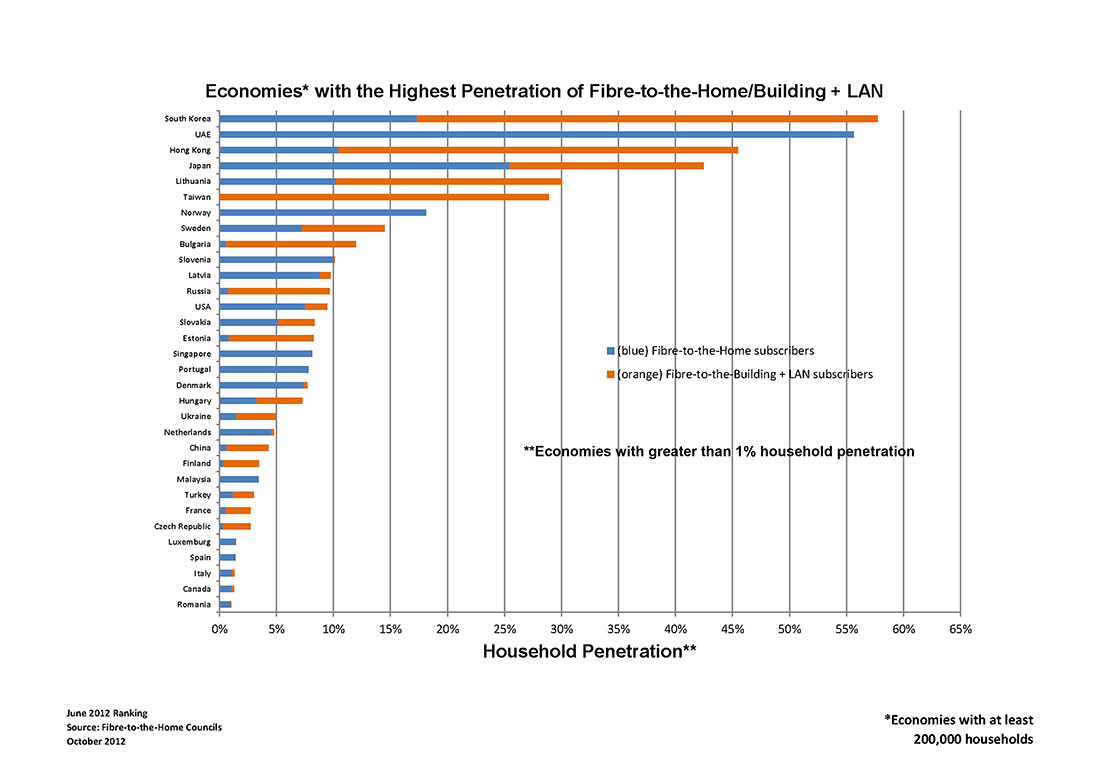
The above chart from the Fibre to the Home Council Europe shows actual subscribers, rather
than the more usual homes passed statistic. The number of subscribers is a much
better metric, as it is far to easy for telco’s to claim large numbers of
properties passed, but be very slow at actually connecting subscribers. What is
very interesting is the proportion of FTTB versus FTTH, FTTB is very popular in
cities across Europe as the costs are much lower than a full fibre deployment,
the UK has been slow in exploiting this sector of the market but Hyperoptic, Magnet and others are increasing the numbers connected.
(Click image for larger version)
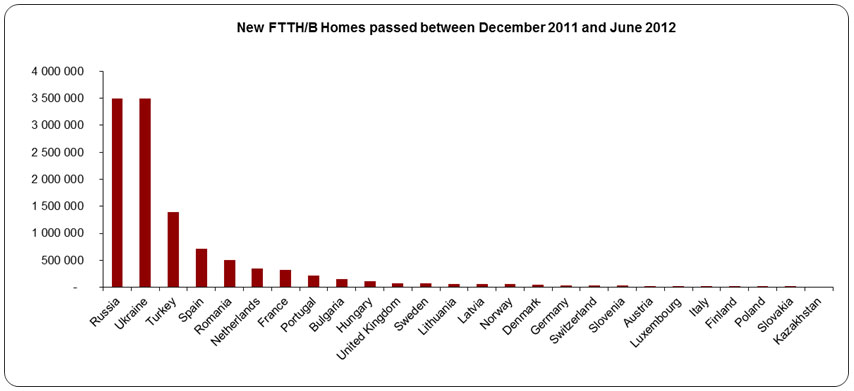
While the UK does not figure on most of the FTTH Council Europe data, if you
look at the six month period for December 2011 to June 2012 we do feature, with
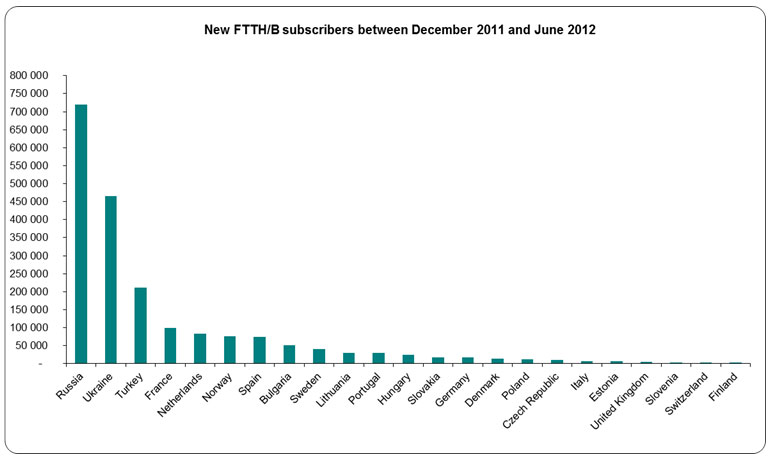
the UK adding more homes passed than Sweden, Norway and Denmark. Though in
terms of actual subscribers these countries do beat us, mainly because their
fibre market is more mature in terms of marketing and existing coverage.
(Click image for larger version)
The FTTH Council Europe does have some data on the UK, which reveals that in
the UK we have around 175,000 homes passed by FTTH/B and 13,000
subscriptions.
| UK Figures in June 2012 | ||
|---|---|---|
| Provider | Subscribers | Homes Passed |
| BT/Openreach | 5,000 | 85,000 |
| CityFibre | Unknown | 30,000 |
| Others | 8,000 | 60,000 |
The key now will be how fast can we in the UK build on these small but
promising figures. While the growing number of rural fibre projects such as
those from B4rn and others will make a massive difference to the local area, it
is actually what Openreach does in 2013 that will be crucial. If the pricing
for its Fibre on Demand product at launch is right, then we may see the full
fibre subscription numbers rapidly rise, out pacing the efforts of all the
other operators. This is not favouritism to Openreach, just a cold reality of
the size of the Openreach footprint which means more than 11 million properties
should have a full fibre option in 2013, though at a higher activation cost
than the areas with dedicated FTTP from Openreach.
Much of the debate on fibre in the UK focuses on rural areas, what is not
clear is whether the UK is actually behind the curve in that area, the work of
IFNL, GigaClear and others in the rural parts of the UK means while the total
numbers connected are low, direct comparisons for similar locations across
Europe may reveal a more rosy picture than the doom and gloom that seems to be
a constant feature of UK broadband lobbying.
 Test your broadband speed
 Follow us on X for the latest broadband news


Why is the propoganda from the so-called FTTH council (ie manufacturers) treated like news? And who cares about this data anyway?
The reports from Akamai and elsewhere show that the hype around FTTB speeds in much of the world is exactly that, otherwise why does South Korea average < 20Mbps average download speeds, which is easily out-performed by my FTTC line?
How is it propaganda? or any more than many other items that show stats around the world, or announce or new products?
Their data is the first real announcement of Openreach FTTP numbers.
Running with it now, gives as the baseline data for a year or two, so we can see how things have or have not progressed.
It will have to do For The Time Being.
What really matters is what is availability, otherwise peasants distort the numbers.
According to the person I spoke to in VM retentions, VM is the only UK ISP to provide FTTH….and its not coax from the cabinet. Just one of her funny claims!
@Joppy
Well it’s no less true than the line that VM offers the fastest widely available broadband. 😉 Not the case for upload speed now, won’t be true either for download when FTTP-on-demand is available.
A true FTTH connection is nothing but a pipe dream here in the UK.
We are a country of “make do” with what you have got rather than “plan ahead” for the future.
With only roughly 180,000 homes passed is a joke.
The problem stems from the fact that even for FTTC, there’s a relatively low takeup as it’s available in same area as cable/VM or they’re close to exchange so get >10Mbs anyway.
‘too easy for telco’s to claim large numbers of properties passed, but be very slow at actually connecting subscribers’. Why is that?
@Somerset
Possibly because of the time and effort to connect people, so we get the massed roll-out, followed by a slower tail as the half day to connect each customer takes place.
My prejudice would be that we have a lot more houses and fewer blocks of flats than some countries. Are there stats for “buildings in multiple occupation” or similar to put the FTTB thing in context ?
FTTB is pretty much deployments to flats or MDU in PR speak
Fibre to the Mdu is very labour intensive and there is no “one solution fits all”. The easiest option is FTTC for the time being.