3G is being switched off around the country and beyond the reality that lots of the kit is old, the benefit being touted is coverage and speeds will be improved. Of course, if you have a 3G device and don’t upgrade to 4G or 5G your service is reduced to 2G but this should be very rare for mobile phones and 2G will still allow calls and messaging.
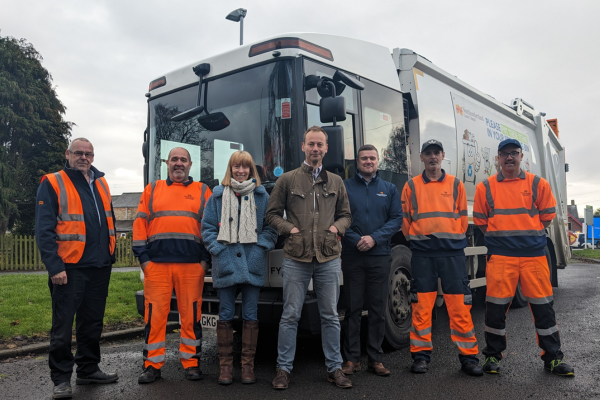
One of the Northumberland waste collection fleet vehicles used in the 3G switch-off monitoring
To see what the impact actually was, rather than rely on the mobile operators themselves Northumberland council has worked with Streetwave to survey the speeds in the county and rather than send out survey vehicles the council waste collection fleet were fitted with mobile monitoring equipment. An advantage of using the rubbish and recycling vehicles is that they travel to all streets in the county and returned repeatedly to the same streets over time.
Ensuring our residents have access to dependable mobile signal is a key priority for the council. It’s fantastic to see that Vodafone’s 3G switch-off is benefiting our communities.
Councillor Richard Wearmouth, Deputy Leader and Cabinet Member for Corporate Services at Northumberland County Council
The results today look at just Vodafone, with the 3G switch-off for the Three and O2 networks scheduled for later in 2024 or 2025. The EE network was already showing no 3G in the area.
The results are broken down as follows:
- 4G detected in 86% of connections in November 2023 rising to 96% in March 2024
- 3G falling from 13% to 0% in the same period
- 2G rising from 1% to 4% in the same period
In theory, the small rise in the amount of 2G areas is not good news, but hopefully continued monitoring will show 4G showing up more. We say in theory, because in places where I’ve previously ended up with 3G on the Vodafone network, IP data throughput falls almost to zero, i.e. the actual difference may be minimal since the 3G signal was already marginal in those areas anyway.
- Essential coverage (i.e. 1 Mbps down and 0.5 Mbps up or better) 89% coverage in Nov 2023 rising to 92% in March 2024
- Average Vodafone download speeds rose from 11.8 Mbps to 12.8 Mbps
- Average Vodafone upload speeds rose from 4.9 Mbps to 5.7 Mbps
The average speeds for mobile are nowhere near what you can see from a 4G network which can manage 200 to 300 Mbps in good conditions. Without access to a profile for the speeds detected it is impossible to know, but given the amount of rural roads the vehicle fleet will have covered to see a low average is to be expected, rather than the marketing dreams.
 Test your broadband speed
 Follow us on X for the latest broadband news


That’s why in Cambridge we see E all the time now …
Also on Vodafone, also now seeing E for EDGE (and sometimes G for GSM/2G) quite often since Voda’s 3G switch-off.
Presume (hope) that the process of refarming the 3G frequencies over to 4G will improve matters as time progresses. I assume that in at least some places this will require mast work.
Using Vodafone. That’s where people are going wrong.
binary – in most cases this should be software configurable on the 4G radio units, assuming this was planned in advance.
ramzez – maybe in the East of the country you’ll be better on O2, whereas in the West of the country Vodafone is better. This insane split is still happening.