A few weeks ago, we reported that BT was speeding up its fibre-to-the-cabinet (FTTC) rollout to get more of
the population connected to faster broadband services.
Yesterday morning, on a busy street in Muswell Hill in North London, we followed a BT engineer who was installing their first FTTC connection to a business premises under this pilot scheme. A few
days earlier, the first consumer connection was completed.
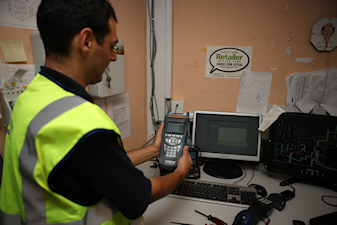
The customer is the East Finchley Budgens store who have been using AAISP for some time and were
keen to get a faster broadband service with faster upload speeds in particular as this would give them the ability to install better remote monitoring solutions for the store and improve their
interactions with suppliers. The store was expecting a ten-fold speed upgrade from its current 4Mbps connection to somewhere up to 40Mbps. The key of course was upstream speed which was recorded at
1.7Mbps which was more than a twice the upload speed available the previous day. It is expected that future upload speeds will reach 10Mbps or even 15 Mbps, addressing concerns expressed by many
about how upload speed increases have not kept up with technology.
“We aim to be at the leading edge of technology at all times and we are delighted to pilot fibre broadband. Taking part in service trials wherever possible, enables our customers to get the best
service possible, stay ahead of their competition and delight their customers. We are pleased that our business customers were the first to be connected to BT’s high-speed fibre broadband service in
East Finchley.We see the increased uplink that FTTC can provide to be key to business customers – surpassing SDSL speeds and allowing previously difficult services such as remote monitoring of surveillance
cameras, and better VPNs in to head office systems.”Adrian Kennard, Director, Andrews & Arnold / AAISP
The BT Openreach engineer installing the connection was excited to be involved in delivering next generation broadband to residents and businesses in Muswell Hill and a BT spokesperson said that
all broadband engineers would be trained for FTTC installs in due course as the rollout programme continues to their respective areas.
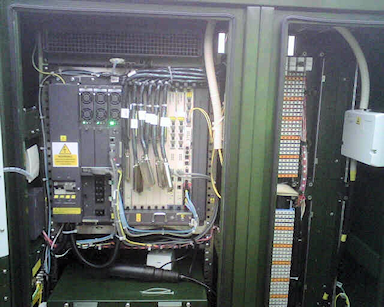
The FTTC solution used by BT is based on the end user premises being connected to a local street cabinet by way of a shorter copper ‘local loop’ running VDSL2. This differs from current generation
broadband where the equipment is housed at the local exchange. With FTTC, the street cabinet includes a DSLAM which terminates the DSL connection and uplinks it by way of Gigabit Ethernet over fibre
to the telephone exchange which is capable of speeds from 1Gbps (1000Mbps) to 10Gbps and multiples thereof.
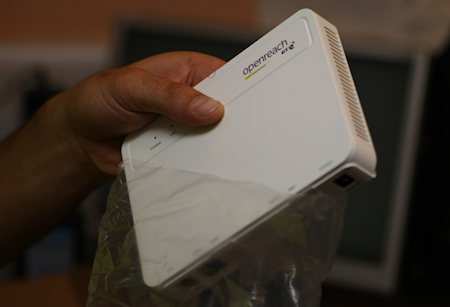
At present, the FTTC VDSL2 solution is an ‘engineer install’ which mirrors the early broadband services offered by BT and makes it easier to test that the connection is working, but we understand
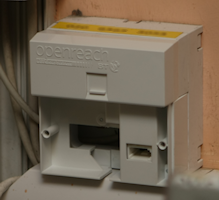
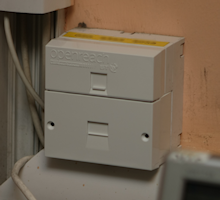
BT is looking at self-install once the technology is more mature. The install involves the installation of an interstitial plate, similar to BT’s I-Plate which acts as a filter to ensure an optimum signal and a dedicated BT managed modem to which a user would connect a PPPoE
router over a standard Fast Ethernet network interface.
It is worth noting that the speed you can get on this service does still depend on the distance from the street cabinet to your premises, but this will inevitably be shorter than from the local
exchange. In this particular case, the street cabinet was next to the wall of the premises in question, although the line distance may still be somewhat longer. This solution is similar to Virgin
Media’s implementation of a fibre-copper hybrid solution (albeit VM uses coaxial rather than copper pair cabling) and gives BT the ability to compete with Virgin’s 50 meg broadband solutions. Virgin
is in early trial stages for faster download speeds up to 200 Mbps and upstream speeds of up to 10Mbps.
 Test your broadband speed
 Follow us on X for the latest broadband news



“The store was expecting a ten-fold speed upgrade from its current 4Mbps connection to somewhere up to 40Mbps. ”
So what was it actually?
“he key of course was upstream speed which was recorded at 1.7Mbps which was more than a twice the upload speed available the previous day.” But less than can be obtained on LLU at the moment…
“t is expected that future upload speeds will reach 10Mbps or even 15 Mbps…”
Good, but when?
Is the FUP altered for this product?
Yeah, 1.7Mbps upstream is really very disappointing given it’s FTTC. I’d be interested to know whether they got close to the 40Mbits downstream.
… given that the DSL line should be no more than a few feet long. How pointless.
Indeed. If the customer equipment is less than 100m from the cabinet, why go to the trouble of converting fibre to copper pair then back to ethernet. Why not just ethernet from the cabinet? Surely one could still run PPPoE on that connection.
Hardly pointless, the line still has to go from the Fibre Cabinet to the copper PCP via a tie cable and through the building to the NTE, so hardly a “few feet”. Search for “Muswell budgens” on street view and take a look, I know for a fact the fibre PCP is next to the yellow grit box (I watched then crane it in) and the copper PCP is the other side of the road outside the pub, so line must easily be over 100feet and yeah would easily get 40Mb line sync.
I wonder how this speed compares to their existing two way satellite connection?
@prlzx – I doubt it would be quite that easy (although long range ethernet exists) to do Ethernet on the basis that very few people would be within 100 metres end-to-end .. you can’t deliver a custom solution for very few people in an environment like this.
@whatever2 – This was one of the first pilots so there are some teething issues both within the ISP-BT link and elsewhere that need sorting out. The only mainstream broadband service that would currently have a faster speed would be Virgin’s 50 meg product so that gives you an indication that we’re talking beyond ADSL2 in any case.
We’ll go back in a few weeks and ask 🙂
@ElBobbo – That DSL line will be a bit longer than you expect as it would have to go back to the street cabinet on the other side of the road, and it might then do a loop possibly.. so you can’t actually tell from sight how long the line would be. (I did ask :-p)
Another difference with VM’s implementation is that they use a cable loop so the bandwidth back to their equivalent of a cabinet is shared by everyone in the neighbourhood.
‘It is expected that future upload speeds will reach 10Mbps or even 15 Mbps, addressing concerns expressed by many about how upload speed increases have not kept up with technology.’
Just wondering, what leads to this expectation given that BT only offer 2Mbps upstream on consumer FTTP in Ebbsfleet and have announced nothing to indicate an increase in FTTN upstream beyond a 5Mbps option?
Not sure when BT started addressing people’s concerns, but Seb if you’ve some info gimme gimme 🙂
@AndrueC – correct. The crunch point on BT’s FTTN solution is the backhaul from cabinet back to exchange, on VM it’s the coaxial segment. That said both could happily run with no visible contention.
I wonder if it’s possible to get line stats from the VDSL2 modem – presumably it has attenuation and SNR margin measured similarly to how they are on ADSL1/2. Not sure Openreach will make the stats on their box easy to get at though.
@Seb
As the “key of course” was upload, I say 1.7 mpbs (less than the 2.3mb i’ve got) would be a good comparison to existing services. If you’re expecting a 10x speed increase up, a 2x down isn’t great if it’s sub LLU which BT compete with.
It would have been more accurate to mention it failed to be right first time, however embarrassing it was on a PR’d launch.
I admire the optimism that it would work fine out of the box.
Don’t get me wrong, it’s interesting(ish) to see it starting, but hopefully, it will be sorted in a shorter time than a few weeks… then we can see what it can do (and the FUP behind it)
Like h2o though, a deafening silence on actual facts isn’t the best way of publicising next gen tech, especially on launch.
Sorry, just read… it was the ISP-BT link…
So what were the sync speeds then?(Assuming throughput was bottlenecked) Or is this suffering some odd SNR thing like some of the new WBC lines.
Im guessing that AAISP had this installed as the 40 down 2 up option of FTTC, they could also choose to have 40/5 but that is an additional cost. It could be as this is the first line they are starting it on the base package and them looking to try the others once they seen how this performs.
the FUP (or otherwise) will be down to the ISP, in this case AA. Openreach run the FTTC product with no contention to the exchange within the committed data rate of 20Mbits/s (or sync speed if slower) downstream.
1.7meg seems dissapointing as the cabinet was close, why not 2.5mbit? and the downstream synch not even reported so yeah I would agree it seems a technical glitch happened.
1.7Mb is very bad if the cabinet is next to the wall of their premises! They must be on bad copper.
We’re 580 meters from the exchange (line of sight) on ADSL2+ annex M and we’re synced at 2.2Mb and achive 2.0Mb upload rate. So we’d expect to get a lot better than that on FTTC.
@whatever2 – I didn’t say it was the ISP-BT link but issues such as the ISP-BT link and elsewhere.. This is one of the first few connections in Muswell Hill so it’s a new pilot.. I don’t know how long it would take to settle down but they are getting speeds faster than anything else could possibly get, except VM 50 meg.. so I think it’s hardly anything to criticise – of course I want them to roll it out quicker 🙂
@nmg196 – the maximum possible at the moment is 2Mbps upload due to restrictions on the product. I suspect this will change very soon to 5 but I’ve heard of 10-15Mbps upstream being considered too.. Also being physically next to the cabinet is not necessarily the same as being “next” to it in terms of line length.. We don’t know what the line length is.
@Drefsab 40/2 is correct on this one.. I don’t know if 40/5 was available yet? I’m sure they will push that up as soon as possible.
The 40/5 isn’t available yet, coming shortly. No 40/10 and 40/15 products under trial or on the price list yet.
Shame they aren’t just doing a ‘Max’ type package given that there’s DLM on the product.
Remember when ADSL rolled out it was 512/256 for ages. I expect something like ‘Max’ will become available eventually.
Hope there’s no DLM.. fighting with that is what has blighted ADSL2 so much. I’m told they’ve finally ditched BRAS as well.
ok apologies for misunderstanding the upstream synch rate, however unable to synch at the full 2meg is still dissapointing considering technically vdsl2 is capable of so much more, and it seems odd noone has reported what the downstream synch is yet.
I presume you mean IP Profiles Tony. In which case no they would still be required for lines which sync below 40Mbps.
Couldn’t really care that ADSL was 512/256 for ages, that was when there wasn’t already a faster product available from cable. Now BT release 40/2 which will be closer to 35/1.7 by the time overheads are taken out. Virgin have a product that delivers 50/1.6 and will be faster upstream wise in the not too distant future.
VDSL with slower upstream than Annex M 2+. Joke.
chrysalis – they probably are synched at 2, take the overheads off and it gets trimmed to the 1.7 mentioned.
BT has a sword it can use against VM though, non-BT ISP’s can offer high usage options (maybe even unmetered again).
“I presume you mean IP Profiles Tony. In which case no they would still be required for lines which sync below 40Mbps.” Why, Dixinormous? LLU providers don’t have BRAS profiles.
Dixi – And let’s not forget VM Oxford’s current consistant -15%- packet loss. One-five.
(Also, faster upstream..lol)
Most people simply don’t need massively fast upstream (per the last conversation, 2MBit can support 16 players in the vast majority of games, even when badly p2p coded) connections.
dawn, next gen products (even tho fttn isnt really next gen) shouldnt aim to just supply the min bandwidth needed they need to be future proof.
Define ‘future proof’.
No, they should aim where they’re commercially viable. As BT have.
somerset well the obvious one would be to provide more than is currently required, so if a product been rolled out only aims to supply today’s needs then it is not future proof. 40mbit down isnt such a big problem, but 2mbit upstream is not future proof.
@seb
but they are getting speeds faster than anything else could possibly get, except VM 50 meg..
The point I was making was that you made the point about the key being upload speed, which is 1.7mb and that’s slower than ADSL2+ offerings using Annex M, (which BT can’t do) and so is not only slower than expected, but slower than existing rivals, not just one.
So as far as upload is concerned, it’s not even matching the current offerings, let alone future.
That’s why i was trying to work out if it’s the tecnology, the install or the package…
Instead of BT playing with spin and mimics, they should concentrate in improving their current infrastructure and give customers acceptable speeds. I get 1.0 Mbps, 1.7 km from the exchange, because according to BT, this exchange (Bearsted, Kent) “is not capable of higher speeds”.
Typing error on previous entry. Instead of “mimics”, please read “gimmicks”.
i think you were right the first time 😀
@Dawn – the higher upstreams are on their way, and I’m not sure if the whole of Oxford are suffering this 15% you talk about – if you’d like to give me the first 3 octets of an IP address which is suffering this I’ll pass them to someone who works for VM to check out, but a quick test to a random Oxfd modem shows no such issues.
Ping statistics for 82.24.254.1xx:
Packets: Sent = 100, Received = 100, Lost = 0 (0% loss),
Approximate round trip times in milli-seconds:
Minimum = 17ms, Maximum = 176ms, Average = 24ms
I came across http://svensktbredband.se/ who provide 200mbit synchronous home internet connections for 229 swedish kronor (£18.84) a month.
It’s possible to get dedicated servers that you can use to pump out 10TB a month (UK2.net).
How can people possibly defend the UK market?
Sure ElBobbo. For one thing, there are considerable government subsidies involved. For two, the coverage of that service is very small.
And I think you’ll find that the market in hosted servers is an entirely different proposition (and is indeed a totally different market), and UK2 have a string of bad reviews…they offer the world and can’t deliver. (Hint: check WHT)
I’m not seeing any details, just claims.
BT’s had its entire network paid for by the government. Sweden has a population density of 1/10th that of the UK.
UK2 may have some bad reviews, but I have a box with them that regularly goes between 3-4TB per month without downtime. How come they can afford to provide that kind of transit? Are BT really providing good value for money – I don’t think so.
BT’s privatisation was via share issue, and inherited a decaying infrastructure largely fit only for telephony from the PTO. You are comparing this to ongoing, expensive Government investment. Not comparable.
And there is a considerable difference in peering between a hosted server and an end-user and there are many, many additional costs on the end-user. As you’d know with a very little research.
Also, you’re mistaking “population density” of a county with “population density of the inhabited areas”, a far more useful metric for broadband.
http://www.bestcountryreports.com/Population_Map_Sweden.html
http://www.bestcountryreports.com/Population_Map_United%20Kingdom.html
Yea, you may now say “oh”.
As in, “Oh, this image is meaningless at best and misleading at worst because they have a population of 9.2M?” Their GDP is an eighth of ours ($300B). Honestly, is this really all you’ve got to justify the piss poor excuses the big companies are giving for not keeping up with other countries?
Do you have _any_ answers? A number? Some figures? A diagram, maybe? For god’s sake, even Croatia has FTTH in the capital city. Romania has FTTH in twenty two cities!
Please, do tell me what the difference is in terms of transit costs for BT – that is, essentially, what they’re claiming is expensive, right (difficult for BT, but apparently easy for some two bit dedicated hosting company)? Or is it the last mile – in which case, why are the caps on traffic so low? It’s funny how no matter which bit you compare, it’s always some other part of the network which is congested and too expensive to improve.
Am I missing something here Dawn? Great swathes of England alongside parts of Scotland, NI and Wales are as populated as Sweden’s cities. We don’t have to deliver the same services everywhere, so at very least a number of our cities could be well covered.
Central govt in Sweden do not have ongoing expensive investment in fibre, it’s been done by local municipalities, as ours could if central government didn’t actively obstruct such deployments.
Even with that Telia still own 45% of all fibre.
“it’s been done by local municipalities”
Council broadband ? God forbid. Look at South Yorks Digital Region and NYNet to see how good we are at delivering that sort of thing.
Eastern Europe has the “advantage” of very poor fixed line telephony under communism hence its easier to justify going straight to fibre to build up their network coverage.
So they can because they’ve got nothing, but we can’t because we have an existing network? Can’t you see how ridiculous that is? Eastern Europe has a GDP dwarfed by the UK, yet they can afford to lay fibre AND price it to the consumer at a level that they can afford.
Herdwick is right. It’s not ridiculous at all, indeed it’s a truism. Quite simply, incrimental improvements (and yes, that is what consumers see it as) are far harder to sell, and cost more to roll out per user.
Dixi/ElBobbo – Sweden dosn’t have the sort of urban sprawl we do and has massive very low population areas, it’s /far/ easier in actual coverage to get most of the population.
And regardless, there is substanial ongoing investment in broadband (and even moreso in Eastern Europe)…and massive whining when the same is proposed here.
Probably because the ‘substantial ongoing investment’ is a pitiful little tax on phone lines and it’s not going to result in anything constructive beyond lining a few pockets.
I notice you didn’t talk about the difference in terms of transit for dedicated server providers and BT.
Sweden has 10% of the houses in the country connected by fibre. Why can’t we even get areas in a few of our major cities connected?
there’s probably a compound of reasons why that’s easier or more likely than in the UK, but remember that 10% of sweden’s households is likely to be the equivalent of 1% of the UK’s.
ElBobbo? No, Sweden has a substanial ongoing investment. The whiners like you utter prevent that here.
If companies wanted to wire up the cities they could…but they haven’t, because it’s not economcal to do so. Competing with ADSL2+ is not pretty in economic terms.
I’d point out the startup in Hull which has had great interest from the locals, because oh how crappy KCom are.
Now you accuse me of somehow holding up investment in next generation broadband? What a load of rubbish.
Frankly your pathetic excuses from the start have simply been a load of denial, which doesn’t surprise me because that’s what these companies do best.
You can’t answer any simple questions, instead changing the goalposts any time things get difficult. Bloody useless.
Oh, and we don’t even need to look at Sweden. We can look at the USA and Verizon – http://is.gd/1RsQ4 – unlike AT&T which is taking the BT route and holding out as long as possible, Verizon decided to actually put some capital in and now it’s really paying off. Pity BT can’t have the balls to actually put some money forward; they’d even save on maintenance.
Verizon are benefiting from tax breaks, and they are not only delivering internet services…and in much of the served zone, there is no or very little competition. Again, this is all about investment and existing infrastructure.
Yes, ElBobbit, that’s precisely what you’re doing. The goalposts remain precisely where they allways were – commercial viability.