
Ofcom has released its annual Connected Nations report, which aims to give a picture of how the UK communications infrastructure is performing and improving and to monitor the availability of both broadband and mobile services across the UK. This article focuses on the mobile network side of the report.
5G rollout
Ofcom is monitoring the 5G rollout of the mobile network operations (MNO) and uses signal strength predictions provided by the four networks to do this. The report looks at 100m x 100m grid cells to determine the coverage, which looks to be different to the Ofcom Map Your Mobile website, which now uses finer granularity of 50m x 50m pixels.
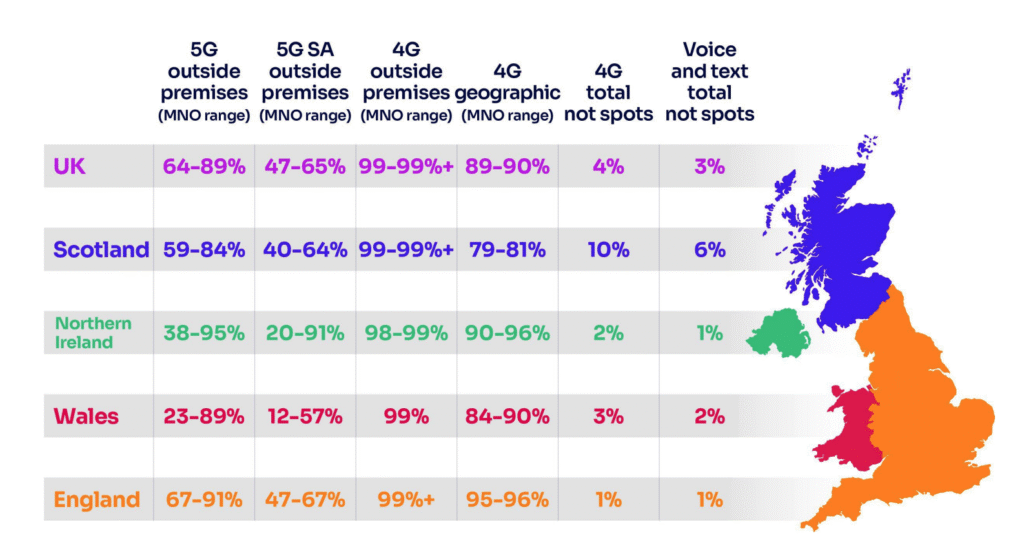
5G standalone (5G SA) coverage is growing – coverage outside of premises in the UK is estimated at 83%, although this is based on all networks, which would not be usable by an average consumer or business user. When looking at individual networks, the coverage decreases to 47% to 65%, depending on the network. Overall 5G coverage outside of buildings from at least one MNO now reaches between 94% and 97%, with the highest operator reporting 89% coverage.
Monthly mobile data usage increased by 18% over the past year, reaching 1,257 petabytes, a growth rate which was consistent with the previous year. 5G made up 28% of this with 348PB being recorded, and 31% of 5G traffic was 5G standalone.
4G coverage and the Shared Rural Network
4G coverage across all networks has reached 99% outside premises, with urban areas seeing levels above this, and rural areas at 94%. Indoor coverage is lower, with ranges of 94-97% UK-wide for all networks. Rural areas only see this coverage reach 78-84% of premises, though, and this is obviously lower when you are tied to just one network.
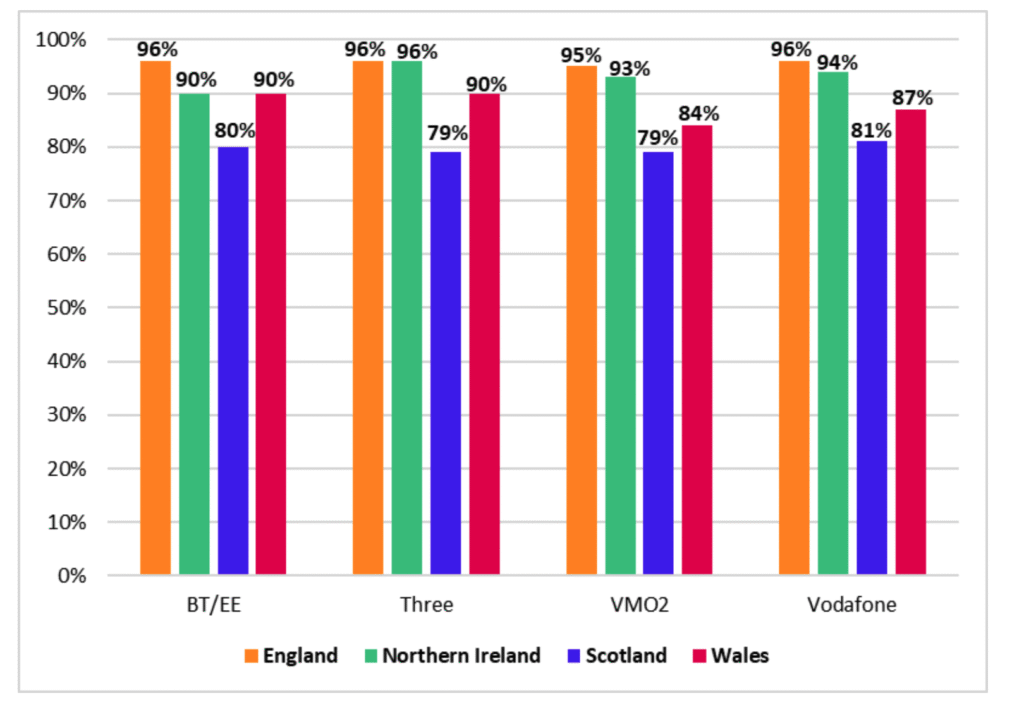
The Shared Rural Network is an agreement the Government made with the MNOs to grant funding for a shared 4G rural network that can be used by all of the operators. In 2024 the network met their obligations to deliver 88% coverage and have continued to maintain this through 2025. Coverage from at least one operator is now available across 95% of the UK landmass. By 2027, MNOs are required to roll out additional sites in ‘Total Not Spot’ areas and also to roll out their network to ‘Extended Area Service’ EAS sites that the Home Office wants to build coverage to improve access in remote areas. These EAS sites have ranged from 55 to 210 sites per operator and add between 0.25% to 1% of UK landmass coverage.
3G and 2G switch-off
Mobile Operators have committed to switching off their 2G and 3G networks by 2033 at the latest, which will free up some spectrum which can be used by 4G and 5G services. 3G switch-off is nearly completed across all MNOs. Three is expected to remove the final areas in November 2025, and Virgin Media O2 is the last network with any significant coverage, which is expected to be turned off by the end of the year. There are still believed to be around 2 million active devices on the 2G and 3G networks, with 1.6 million of these identified as consumer devices like mobile handsets.
2G switch-off is some time away still – EE will begin in May 2029, whilst VodafoneThree is expected to switch off services in 2030. Virgin Media O2 has yet to announce a date, but inbound roaming has been stopped from October 2025.
 Test your broadband speed
 Follow us on X for the latest broadband news




Leave a reply